

A Story of Structure, Pressure, and a Costly Fix
Many founders think that setting up a company in the UAE is simple. Select a free zone, obtain a license, open a bank account, and begin selling.
That can work at the start. But once the business grows, the real pressure begins. Jurisdiction decisions shape corporate tax position, client onboarding, audits, and most importantly, your ability to secure a stable corporate bank account in the UAE. In practice, the early choice is not paperwork. It is a strategy.
How It Started Speed Before Fit
The founder was introduced to our team, but chose another advisor because they promised speed. The company was incorporated in a popular free zone that many consultants use for quick licensing.
At the setup stage, key questions were not properly mapped. This later created significant challenges in opening real business bank accounts in the UAE, especially when larger clients and banks increased their scrutiny.
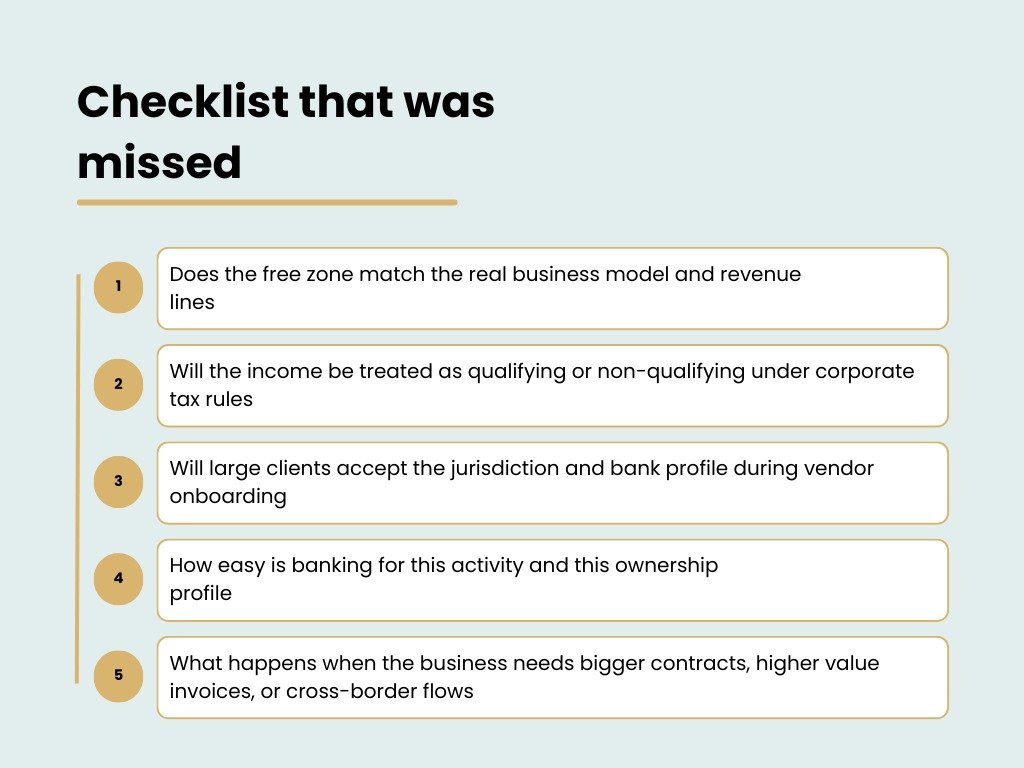
The goal became simple. Register fast.
After incorporation, the founder built momentum. Accounts were opened, suppliers were onboarded, contracts were signed, and payment workflows were running. Everything looked stable until enforcement, compliance checks, and bank risk reviews became stricter across the market.
The Turning Point When Reality Caught Up
A few months later, the founder came back to us for operational and finance support. We onboarded the business for advisory and accounting services and reviewed the structure end-to-end.
The issue became clear quickly. The chosen free zone did not fit the activity and client profile. It also created avoidable exposure on tax treatment and day-to-day operations.
This was the hardest conversation. By then, the business was already built around the existing entity. Changing course meant undoing months of work and explaining it to every stakeholder, while keeping banking running.
The Real Struggle: It Was Not Just Legal
Restructuring sounds procedural on paper. In real life, it hits operations, trust, timelines, and emotions. It also impacts business bank account Dubai continuity, vendor records, and ongoing client payments.
1: Large Clients and Vendor Onboarding
The founder worked with multinational and large-scale clients. These organizations have strict onboarding processes.
When you change an entity or banking details, it can mean restarting the full chain of approvals. Compliance teams, procurement, finance, and legal often need to revalidate documents and risk checks. In practice, it can take weeks and sometimes months. Deals that felt closed suddenly became open again.
2: Supplier KYC Trust Had to Be Rebuilt
Suppliers run their own KYC before they continue a relationship. They ask for updated licenses, corporate documents, ownership confirmations, and signatory proofs.
Every request triggered a new round of questions. The founder had to communicate clearly so suppliers would not read the changes as a risk signal. This is where UAE banking KYC assistance becomes practical, not optional.
3: A Market Sensitive to Fraud
Across the UAE and globally, invoice fraud is a real concern. Many businesses have seen fake emails that try to change payment instructions.
Because of that, any request to update bank details is treated with caution. Clients often require verification calls, formal letters, and repeated documentation. A simple update turns into a credibility exercise, and banks will often ask for stronger AML compliance services, UAE documentation in the background.
4: Managing Perception During the Transition
Telling clients, please update your records and pay a different legal entity, naturally raises questions.
Clients may worry about compliance issues, continuity, or stability. Managing these concerns required calm communication, proof documents, and reassurance that service would continue without disruption.
5: Restarting Banking Momentum Slows Down
Corporate banking in the UAE can be rigorous. Banks assess business model, source of funds, transaction patterns, and risk profile.
During account opening or re-opening, cash flow can slow down. Payments get delayed, contracts stay pending, and planning becomes harder. This is where UAE corporate banking services and UAE banking compliance services need to be handled in a structured way.
The Emotional Weight What Founders Often Do Not Say
Behind the structure change, there was personal pressure. The founder was protecting relationships, answering hard questions, keeping the team focused, and staying calm while timelines moved.
Restructuring is not only technical. It is emotional and exhausting when it happens after the business has already started moving.
The Decision Correcting the Course
After evaluating the options, the founder decided to fix the structure properly. We worked with him on a controlled transition plan.
What we did:
- De registered the existing entity in a compliant way
- Designed a new setup that matched the activity, clients, and long-term plan
- Incorporated in a more suitable jurisdiction
- Mapped corporate tax considerations and practical operating flow
- Rebuilt the banking and compliance file to support future scale
The transition required effort, but it gave the business a stable base for growth. It also reduced the risk of a corporate bank account being rejected in the UAE during new onboarding.
What This Case Reinforces
A jurisdiction should not be picked because it is popular, cheap, or fast.
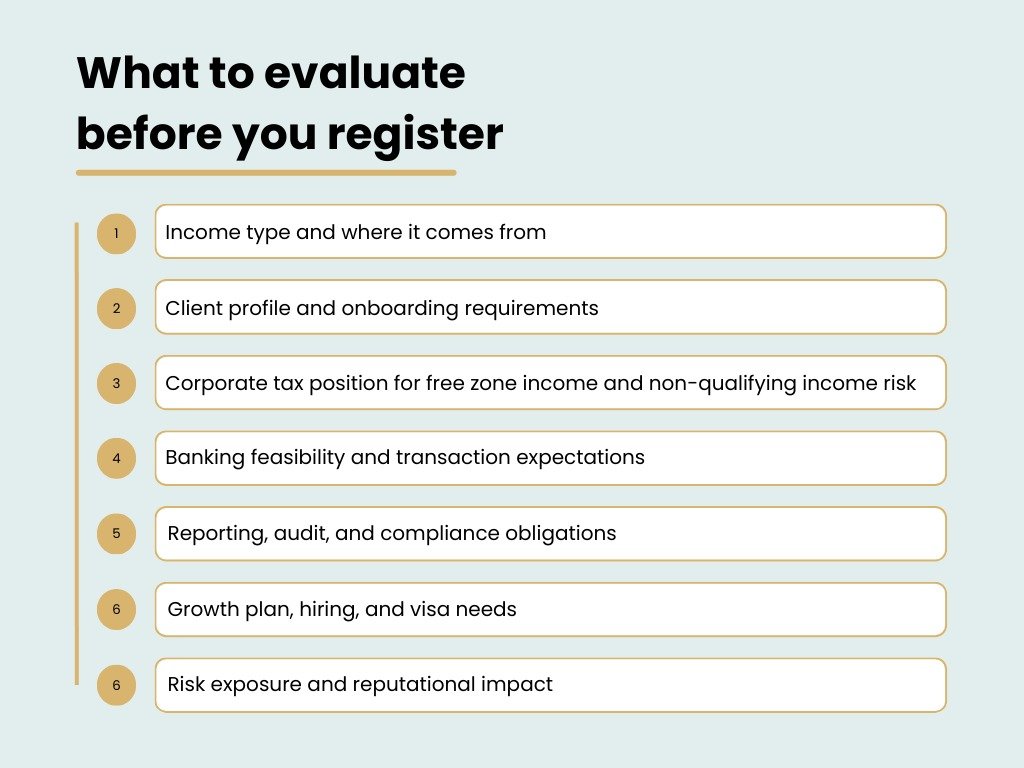
It should be selected based on how the business earns revenue, who it sells to, and what regulators and banks will expect.
A good setup decision balances these areas:
The Lesson for Founders
The cost of a wrong structure is rarely only tax.
It shows up as lost time, disruption, strained relationships, slower payments, and stress. Planning correctly at the start usually costs less than fixing it later.
Our Approach at IncHub
Our approach is simple. Structure comes before registration.
We help founders and investors align jurisdiction, tax position, and operating reality from day one. That includes planning for business banking in the UAE free zone realities, and building a clean compliance file early, so the business can scale without needing a reset.
When the situation involves DMCC entities, our team supports DMCC banking assistance and banking assistance for DMCC companies to help move faster with fewer surprises.
Final Reflection
If you are setting up or scaling in the UAE, ask yourself two questions.
Where can I register quickly?
Where will my business operate confidently with clients, banks, and tax rules
The second question is the one that protects your future.