
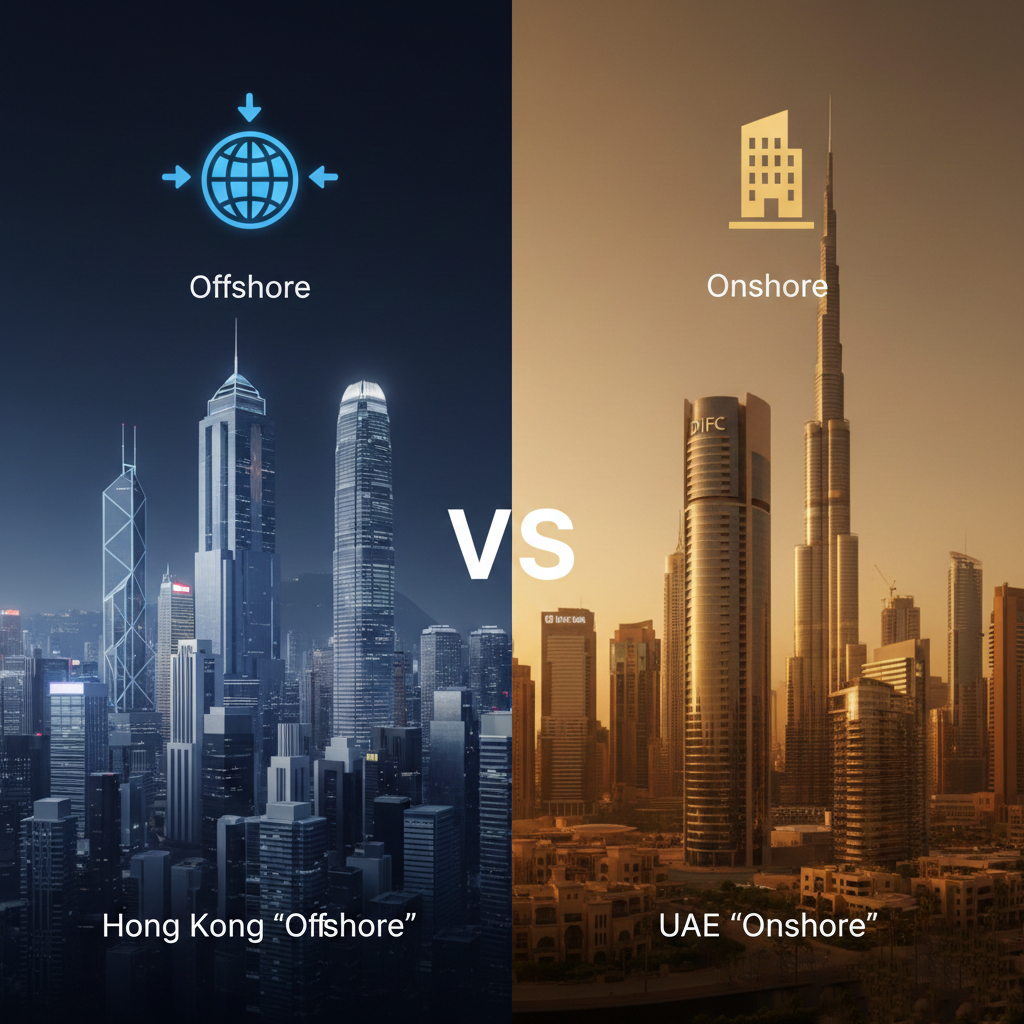
A Clear, Honest Guide for Online & E-Commerce Business Owners Who Want Freedom to Move
In today’s digital economy, most online founders are not tied to one country.
They run e-commerce stores, SaaS platforms, subscription apps, digital services, marketplaces, and online communities—often while travelling, working remotely, or living in a country different from where the company is registered.
This is where one common question arises:
Should I set up a Hong Kong offshore company or a UAE onshore company?
This blog is written for real founders, not tax theorists.
It explains both structures honestly, in simple language, covering:
- tax reality (not marketing claims),
- double tax treaty risks,
- costs including accounting & maintenance,
- challenges faced by non-resident founders,
- and practical scenarios for online businesses.
No hype. No fear-mongering. Just clarity.
Understanding the Two Structures (In Simple Terms)
1: What People Mean by “Hong Kong Offshore Company”
There is no separate legal entity called a “Hong Kong offshore company.”
What people actually mean is:
- a Hong Kong–incorporated company
- that claims its profits are sourced outside Hong Kong
- and therefore seeks 0% Hong Kong profits tax under Hong Kong’s territorial tax system
This is a tax position, not a guaranteed benefit.
It works only if you can prove:
- where customers are managed,
- where contracts are negotiated and approved,
- where key business decisions are made,
- where services are performed.
In short: you must justify the offshore claim every year.
2: What a UAE “Onshore” Company Really Is
A UAE onshore company (mainland or free zone) is a resident company under UAE law.
The UAE now has a clear corporate tax framework:
- 0% tax on taxable profits up to AED 375,000
- 9% tax above AED 375,000
For certain free zone companies, there is also:
- 0% tax on “Qualifying Income”
- 9% on non-qualifying income
This makes the UAE more rule-based and predictable for many founders.
Why Online Founders Face Tax Issues Even When the Company Is Abroad
This is the part most blogs avoid—but it matters the most.
Many founders say:
“I’ll register abroad, but I’ll keep travelling or living in my home country.”
Here’s the risk:
Tax authorities don’t only look at where the company is registered.
They also look at:
- where the founder lives,
- where key decisions are made,
- who controls the company,
- and whether profits are being parked offshore.
Two concepts are critical:
1: Controlled Foreign Company (CFC) Rules
Many countries have rules that tax foreign companies owned by their residents, even if the company is registered abroad.
If:
- you live in a high-tax country, and
- you own/control a low-tax foreign company,
your home country may still tax the profits.
This risk exists regardless of Hong Kong or UAE.
2: Place of Effective Management (POEM)
Some countries treat a company as tax resident where it is effectively managed, not where it is registered.
If:
- all decisions are taken by you,
- from your home country,
- with no real management elsewhere,
your foreign company may still be taxed as if it were local.
This is why “cheap offshore” setups often fail in practice.
Double Tax Treaty (DTT): The Most Misunderstood Topic
Many founders believe:
“If I have a treaty country company, I’m protected.”
That’s not how treaties work.
Hong Kong Treaty Reality
Hong Kong can issue a Certificate of Resident Status, but:
- it does not guarantee treaty benefits
- the other country decides whether the company truly qualifies
If profits are claimed as “offshore” and the founder is not resident in Hong Kong, treaty benefits can be challenged or denied.
UAE Treaty Reality
The UAE has a wide treaty network and a formal Tax Residency Certificate (TRC) process.
Treaties work best when:
- the company is genuinely resident,
- the structure is commercially logical,
- there is consistency between licence, banking, and operations.
UAE does not automatically solve home-country tax issues—but it is often easier to explain and defend when structured properly.
Add Local Director vs Offshore Founder: What Actually Helps?Heading Text Here
A common belief:
“If I appoint a local director, I’m safe.”
Reality:
- A local director helps with substance and credibility
- But it does not override CFC or POEM rules if:
- you still control everything,
- major decisions are taken from your home country
Substance must be real, not cosmetic.
Cost Comparison: Setup + Ongoing Maintenance (Transparent View)
Below is a realistic budgeting perspective, not a marketing headline.
UAE – Entry-Level, Scalable Structure
Typical starter setup (no visa):
- Licence & incorporation packages in some free zones start around AED 4,888
- Virtual office / registered address included
Annual ongoing costs you should budget:
- licence renewal
- accounting & bookkeeping (depends on transactions)
- corporate tax compliance
- optional audit (depending on jurisdiction and scale)
Strength:
You can start lean and upgrade later (visa, office, staff, activities).
Hong Kong – Lower Setup Cost, Higher Long-Term Compliance
Government costs (indicative):
- incorporation filing fees
- annual return fees
- business registration renewal
What increases real cost over time:
- mandatory company secretary
- registered office
- accounting & audit readiness
- additional work if offshore profits are questioned
Reality:
HK is rarely “set and forget.” Compliance effort grows as revenue grows.
Scenario-Based Comparison (Real Life Examples)
Scenario 1: E-commerce Founder Living in Europe
- Shopify + Stripe
- global customers
- founder lives in home country
Hong Kong Offshore:
- offshore claim must be proven
- home country may apply CFC rules
- banking questions likely
UAE Onshore:
- clear tax rules
- easier payment gateway alignment
- better long-term scalability
Result: UAE often easier to manage and explain.
Scenario 2: App Founder, Employed Now, Full-Time Later
- subscription app
- no visa needed now
- wants flexibility
UAE Advantage:
- start without visa
- upgrade later
- predictable tax path
- operational story grows with business
Scenario 3: Founder in a Country Aggressive on Offshore Structures
- profits retained offshore
- no real substance elsewhere
Outcome (HK or UAE):
- home country may still tax profits
- offshore structure alone does not solve tax exposure
Key lesson:
Structure must match personal tax reality, not just incorporation cost.
Which Structure Is Better for Most Online Founders?
UAE Is Usually Better If You Want:
- flexibility to travel
- predictable tax rules
- scalable structure
- payment gateways & partnerships
- future visa/residency options
- lower long-term compliance friction
Hong Kong Can Work If:
- profits are genuinely offshore
- you can maintain documentation
- you are comfortable with scrutiny
- your home country exposure is managed
There is no universally “best” option—only the best-aligned structure.
Final Thought: Offshore Is Not About Tax Avoidance—It’s About Alignment
The biggest mistake founders make is choosing a structure before understanding:
- where they live,
- how they operate,
- and how tax authorities think.
At Inchub, we don’t sell jurisdictions.
We design defensible, scalable, and compliant structures.
Frequently Asked Questions (FAQ)
Is Hong Kong offshore completely tax-free?
No. It depends on whether you can prove profits are sourced outside Hong Kong.
Is UAE really tax-free?
UAE has corporate tax. Some income can be 0%, but only if conditions are met.
Can I avoid tax by staying mobile?
No. Tax residency is based on facts, not travel frequency.
Do I need to live in UAE to have a UAE company?
No, but residency helps with treaties, banking, and long-term planning.
Is accounting mandatory in both jurisdictions?
Yes. Both require proper bookkeeping. HK often requires higher audit readiness.
Can Inchub advise on both structures?
Yes. We advise on UAE, Hong Kong, and cross-border structuring holistically.
Author
Inchub Corporate Services Providers LLC
Inchub is a UAE-based corporate services and structuring advisory firm specialising in business setup, tax structuring, accounting, compliance, and cross-border advisory for startups, SMEs, and international founders.
We work with clients across e-commerce, digital platforms, SaaS, consulting, and online businesses, helping them build structures that are legally compliant, tax-efficient, and future-ready—without shortcuts.
This article is for educational purposes only and does not constitute legal or tax advice. Each structure must be evaluated based on individual circumstances.