
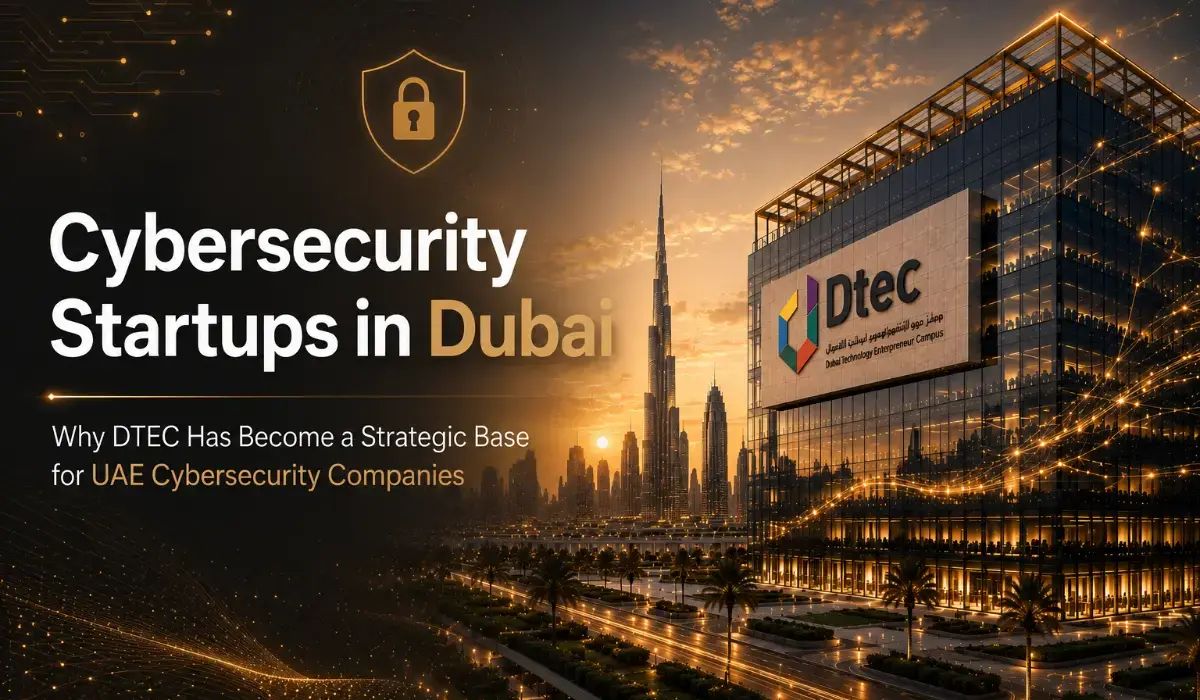
Cybersecurity startups in Dubai increasingly choose Dubai Technology Entrepreneur Campus (DTEC) because the free zone sits at the intersection of enterprise technology, government digital transformation, and the UAE’s expanding cybersecurity economy. DTEC permits cybersecurity consulting, penetration testing, managed security services, cloud security, security software development, and cyber risk advisory activities under its technology licensing structure, making it one of the most relevant UAE free zones for founders building security-focused technology businesses.
For cybersecurity founders targeting the UAE market, location matters far beyond licensing cost. The commercial value of DTEC comes from ecosystem proximity. The campus operates within Dubai Silicon Oasis, one of the UAE’s largest technology districts, where enterprise software firms, infrastructure providers, AI companies, fintech businesses, and government-adjacent technology operators create ongoing demand for cybersecurity expertise.
As cybersecurity regulation expands across the UAE banking sector, critical infrastructure, healthcare, telecom, logistics, and government procurement frameworks, the UAE market is increasingly becoming a serious regional hub for cybersecurity services and security technology providers.
Why Cybersecurity Companies Are Choosing DTEC in Dubai
Cybersecurity is no longer treated as a niche technical sector in the UAE. It has become part of national infrastructure policy.
The UAE government has invested heavily in cybersecurity resilience through initiatives led by the UAE Cybersecurity Council, the Telecommunications and Digital Government Regulatory Authority (TDRA), the Central Bank of the UAE (CBUAE), and multiple sector-specific regulators. These initiatives are creating sustained commercial demand for cybersecurity consulting, cloud security architecture, compliance advisory, penetration testing, incident response, and managed security operations.
For founders, this changes the market dynamics significantly.
Instead of operating in a market where cybersecurity services are optional, companies entering the UAE increasingly face mandatory compliance obligations tied to cybersecurity governance, data protection, operational resilience, and third-party vendor management. That creates recurring demand for specialist security providers.
DTEC aligns well with this environment because its ecosystem already contains the types of companies that purchase cybersecurity services:Cybersecurity is no longer treated as a niche technical sector in the UAE. It has become part of national infrastructure policy.
The UAE government has invested heavily in cybersecurity resilience through initiatives led by the UAE Cybersecurity Council, the Telecommunications and Digital Government Regulatory Authority (TDRA), the Central Bank of the UAE (CBUAE), and multiple sector-specific regulators. These initiatives are creating sustained commercial demand for cybersecurity consulting, cloud security architecture, compliance advisory, penetration testing, incident response, and managed security operations.
For founders, this changes the market dynamics significantly.
Instead of operating in a market where cybersecurity services are optional, companies entering the UAE increasingly face mandatory compliance obligations tied to cybersecurity governance, data protection, operational resilience, and third-party vendor management. That creates recurring demand for specialist security providers.
DTEC aligns well with this environment because its ecosystem already contains the types of companies that purchase cybersecurity services:
For an early-stage cybersecurity startup, proximity to these buyers can materially reduce sales friction and accelerate partnership opportunities.
What Cybersecurity Activities Are Permitted at DTEC?
DTEC supports a wide range of cybersecurity and information security business activities under its technology licensing framework.
Commonly approved cybersecurity activities include cybersecurity consulting and advisory services, vulnerability assessment and penetration testing, security software development, managed security services, identity and access management solutions, cloud security implementation, cyber threat intelligence services, digital forensics support, incident response advisory, and security operations centre (SOC) services.
This flexibility is important because many cybersecurity startups evolve rapidly after incorporation. A founder may initially launch as a consultancy and later transition into software development, managed detection services, compliance automation, or enterprise security platforms. DTEC’s technology-oriented framework provides room for that operational evolution.
However, some activities involving regulated sectors, encryption technologies, surveillance systems, or government contracts may require additional approvals depending on the specific use case and client category.
The UAE Cybersecurity Market Is Growing Because Regulation Is Expanding
One of the biggest reasons cybersecurity startups perform well in the UAE is that regulation is actively increasing security spending across both public and private sectors.
Federal Decree-Law No. 34 of 2021 on combating cybercrime strengthened the UAE’s legal framework around digital misuse, unauthorised access, and cyber-related offences. At the same time, sector regulators have introduced increasingly detailed cybersecurity compliance requirements.
The Central Bank of the UAE has implemented cybersecurity risk management expectations for licensed financial institutions. Financial firms operating in the UAE are expected to maintain formal cybersecurity controls, vendor assessment procedures, incident response capabilities, and operational resilience frameworks.
Healthcare operators, telecom companies, logistics businesses, aviation entities, and government suppliers also face sector-specific cybersecurity obligations that continue to evolve as the UAE digitises critical infrastructure.
This matters commercially because regulatory pressure directly drives cybersecurity procurement.
Companies that previously treated cybersecurity as a secondary IT expense are now allocating dedicated budgets toward:
For cybersecurity startups entering the UAE market, this creates a business environment with genuine enterprise demand rather than speculative interest.
Why Dubai Silicon Oasis Creates Strategic Advantages for Security Startups
Most cybersecurity firms succeed through trust, referrals, partnerships, and long-term enterprise relationships rather than pure outbound sales.
This is where DTEC’s physical ecosystem becomes strategically important.
Dubai Silicon Oasis contains a dense concentration of technology companies, startup accelerators, enterprise software providers, digital infrastructure businesses, and government-linked innovation initiatives. Many of these companies either require cybersecurity services internally or sell into industries where cybersecurity compliance has become embedded in procurement requirements.
A cybersecurity startup operating from DTEC gains direct proximity to:
For early-stage founders, these ecosystem effects can materially shorten the time required to build commercial credibility in the UAE market.
This is particularly relevant for managed security providers, compliance advisory firms, cloud security consultants, and B2B SaaS security companies that rely heavily on enterprise relationship networks.
Penetration Testing and Cybersecurity Compliance in the UAE
Penetration testing is permitted in the UAE when conducted lawfully and with explicit authorisation from the client organisation.
This distinction is extremely important.
Unauthorised security testing, scanning, or access attempts may fall under UAE cybercrime legislation even if conducted without malicious intent. Professional cybersecurity firms operating in Dubai therefore rely on formal engagement documentation, written authorisation letters, defined scopes of work, and controlled testing procedures before beginning any assessment activity.
Founders entering the UAE cybersecurity sector should treat legal process and client documentation as part of operational risk management rather than administrative formality.
Enterprise clients in the UAE increasingly expect cybersecurity vendors to demonstrate:
and recognised frameworks such as ISO 27001, NIST, CIS Controls, or SOC-related governance standards.
Export Control Considerations for Cybersecurity Technology Companies
Some cybersecurity technologies may trigger export control considerations depending on how the software is used internationally.
This becomes relevant for companies developing:
The UAE maintains export control frameworks aligned with international standards, particularly for technologies that could have military, intelligence, or dual-use applications.
Many early-stage founders overlook this area entirely until they begin cross-border sales discussions.
Cybersecurity startups planning to sell internationally should assess export control exposure early, particularly if targeting regulated industries, government buyers, defence-related sectors, or international security markets.
Can Cybersecurity Startups Sell to UAE Government Entities?
Yes, but government procurement in the UAE operates differently from standard private-sector sales.
Many UAE government cybersecurity projects involve:
A DTEC company can absolutely participate in government-linked projects, particularly through subcontracting relationships or strategic partnerships. However, founders targeting large-scale direct government procurement may eventually consider adding a mainland structure depending on procurement eligibility requirements.
In practice, many cybersecurity startups initially enter the market through enterprise consulting, channel partnerships, or managed services before moving into larger public-sector opportunities.
Is DTEC a Good Choice for a Cybersecurity Startup in Dubai?
For many founders, yes.
DTEC combines relatively efficient setup structures with one of the UAE’s strongest technology-focused startup ecosystems. More importantly, it places cybersecurity founders inside a commercial environment where digital transformation, cloud adoption, AI implementation, fintech growth, and enterprise software expansion are actively increasing cybersecurity demand across the UAE economy.
The long-term opportunity is not simply company formation.
The real advantage is positioning a cybersecurity business inside a market where regulation, infrastructure investment, government digitisation, and enterprise technology adoption are all moving in the same direction.
For cybersecurity founders building in the Middle East, that alignment matters.
Frequently Asked Questions
Do I need government approval to provide penetration testing services in Dubai?
No general cybersecurity licence approval is required specifically for penetration testing services, but every engagement must be explicitly authorised by the target organisation. Conducting security testing without written authorisation may violate UAE cybercrime laws.
Can a DTEC company sell cybersecurity services to banks in the UAE?
Yes. However, financial institutions in the UAE typically require vendors to comply with strict cybersecurity, risk management, and third-party governance standards. Many banks also require documented compliance frameworks and enterprise-grade security controls before onboarding vendors.
Is ISO 27001 important for cybersecurity startups in Dubai?
Yes. ISO 27001 is widely recognised across the UAE enterprise and government sectors and is often expected when working with large organisations, financial institutions, healthcare operators, or government-related entities.
Can foreign founders fully own a cybersecurity company at DTEC?
Yes. DTEC allows 100% foreign ownership under its free zone structure, which is one of the reasons international cybersecurity founders use it as an entry point into the UAE market.