
Direct Answer
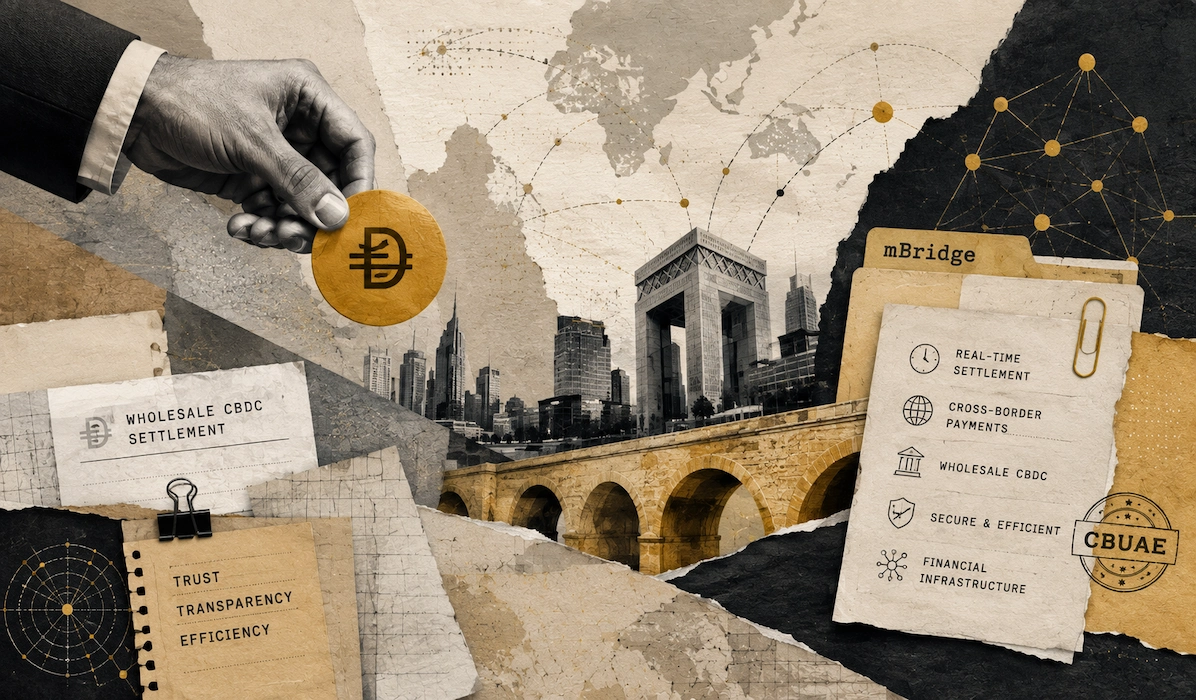
The UAE Digital Dirham has completed its first live wholesale central bank digital currency (CBDC) settlement through mBridge, the multi-CBDC platform operated by the Central Bank of the UAE (CBUAE) in collaboration with the central banks of China, Hong Kong, Thailand, and Saudi Arabia. Unlike earlier pilot programmes, this is a live settlement involving real-value transactions.
The mBridge platform continues expanding throughout 2026 with additional participating countries and higher transaction volumes. The UAE Digital Dirham operates alongside the CBUAE-approved retail stablecoin layer, including AE Coin (DDSC), and the existing UAE banking system. For businesses trading with countries in the mBridge corridor, the new settlement infrastructure has the potential to improve payment speed, reduce costs, increase transparency, and lessen dependence on traditional correspondent banking.
Sources: Khaleej Times (June 2026); CBUAE Digital Dirham announcements; WAM; BIS mBridge documentation.
Key Points
- The UAE Digital Dirham has completed its first live wholesale CBDC settlement through mBridge, confirming the platform is operational rather than a pilot.
- mBridge currently connects the central banks of the UAE, China, Hong Kong, Thailand, and Saudi Arabia, with further expansion planned throughout 2026.
- mBridge is a wholesale CBDC platform designed for large-value cross-border settlements between participating financial institutions. It is not a retail payment system.
- The UAE Digital Dirham operates separately from the CBUAE-approved retail stablecoin AE Coin (DDSC). The wholesale CBDC supports interbank settlement, while AE Coin is intended for retail and commercial payments.
- The UAE’s Stored Value Facilities (SVF) framework, under which Crypto.com received the first SVF licence in May 2026, supports the retail digital payment ecosystem alongside the wholesale Digital Dirham infrastructure.
- Businesses trading with mBridge corridor countries could benefit from reduced correspondent banking costs, quicker settlement, and improved payment transparency as adoption grows.
- mBridge uses a distributed ledger jointly maintained by participating central banks, including the CBUAE, People’s Bank of China, Hong Kong Monetary Authority, Bank of Thailand, and Saudi Central Bank.
- The Bank for International Settlements (BIS) Innovation Hub coordinates the project, with the UAE serving as one of the founding participants.
What mBridge Is and How It Works
The UAE Digital Dirham operates through mBridge, a multi-CBDC platform that enables participating central banks to settle cross-border payments directly using their own digital currencies. Instead of relying on multiple correspondent banks or traditional SWIFT messaging, mBridge allows participating institutions to complete settlements on a shared distributed ledger.
The platform was jointly developed by the Bank for International Settlements (BIS) Innovation Hub, the Central Bank of the UAE (CBUAE), the People’s Bank of China, the Hong Kong Monetary Authority (HKMA), and the Bank of Thailand. Saudi Arabia later joined as a full participant, strengthening the network across key regional and international trade corridors.
Under the traditional correspondent banking model, an international payment from a UAE bank to a bank in China may pass through several intermediary banks before reaching its destination. Each intermediary can introduce additional fees, compliance checks, processing delays, and operational risks. As a result, cross-border settlements typically take between two and five business days.
The mBridge platform streamlines this process by allowing participating central banks to settle transactions directly using their respective central bank digital currencies. Currency conversion occurs within the platform, significantly reducing intermediaries and shortening settlement times. Depending on the transaction, payments can be completed within seconds or a few hours rather than several days.
The successful completion of the first live wholesale UAE Digital Dirham transaction demonstrates that the infrastructure has progressed beyond proof-of-concept testing. It confirms that participating financial institutions are now processing real-value settlements using the platform.
As more countries and commercial banks join mBridge throughout 2026 and beyond, the platform is expected to support higher transaction volumes and broader cross-border trade. For UAE businesses importing from or exporting to participating economies, this evolving payment infrastructure could improve operational efficiency, reduce transaction costs, and strengthen international trade relationships.
The Two-Layer UAE Digital Currency Architecture
The UAE Digital Dirham forms part of a broader digital payments strategy built on two complementary layers. While both support the UAE’s financial infrastructure, they serve different users and purposes.
| Layer | Instrument | Operator | Primary Purpose | Access |
|---|---|---|---|---|
| Wholesale CBDC | UAE Digital Dirham (Wholesale CBDC) | Central Bank of the UAE (CBUAE) | Enables large-value cross-border and interbank settlements through the mBridge platform without relying on correspondent banking networks. | Central banks, commercial banks, and authorised financial institutions. Not directly available to businesses or consumers. |
| Retail Digital Payments | AE Coin (DDSC) and other CBUAE-approved stablecoins | Licensed private issuers regulated by the CBUAE | Supports retail, commercial, and selected government payments in UAE dirhams through licensed payment providers. | Businesses and consumers using authorised payment platforms. |
| Traditional Banking | UAE Dirham (AED) | Commercial banks under CBUAE supervision | Continues to support domestic and international banking, lending, deposits, and payment services alongside digital currency initiatives. | All individuals and businesses with UAE bank accounts. |
This two-layer model enables the UAE to modernise payment infrastructure without disrupting the existing banking system. While the UAE Digital Dirham focuses on wholesale settlement between financial institutions, retail payment solutions such as AE Coin extend digital payment capabilities to businesses and consumers.
What This Means for UAE Businesses
Although the UAE Digital Dirham currently operates only at the wholesale banking level, it has important implications for businesses involved in international trade. Companies will continue making payments through their existing banking channels, but the underlying settlement infrastructure used by participating banks is becoming faster, more transparent, and more efficient.
As adoption of mBridge expands, UAE businesses trading with China, Hong Kong, Thailand, Saudi Arabia, and future participating countries could benefit from several operational improvements.
Lower Cross-Border Payment Costs
International wire transfers often rely on multiple correspondent banks, with each intermediary charging processing and settlement fees. By enabling direct settlement between participating central banks, the UAE Digital Dirham can reduce reliance on these intermediaries.
Over time, lower settlement costs for banks may translate into more competitive pricing for businesses making cross-border payments within the mBridge corridor.
Faster Settlement Times
Traditional international transfers typically require two to five business days to settle because payments pass through several banking institutions and compliance checks.
Using mBridge, participating financial institutions can complete settlements in significantly less time, often within hours and, in some cases, seconds. Faster settlement improves liquidity, strengthens supplier relationships, and helps businesses manage working capital more efficiently.
Greater Payment Transparency
One of the long-standing challenges of correspondent banking is limited visibility during payment processing. Businesses often struggle to determine where a payment is within the settlement chain.
Because mBridge operates on a shared distributed ledger maintained by participating central banks, authorised institutions have improved visibility into transaction status, helping reduce uncertainty and making payment tracking more efficient.
Reduced Currency Conversion Complexity
Businesses trading with partners in China, Hong Kong, Thailand, and Saudi Arabia frequently incur additional costs through multiple foreign exchange conversions.
The UAE Digital Dirham and mBridge infrastructure enable more direct settlement pathways between participating currencies, potentially reducing unnecessary conversion steps, transaction costs, and settlement delays.
Improved Cash Flow Management
Faster settlement cycles allow businesses to receive funds sooner and pay overseas suppliers more efficiently. Reduced settlement delays can improve cash flow planning, lower short-term financing requirements, and enhance overall treasury management for companies with regular international transactions.
Strengthening UAE Trade Competitiveness
As the UAE continues expanding its digital financial infrastructure, businesses operating within major international trade corridors may benefit from improved payment efficiency and lower transaction friction. This supports the country’s broader objective of becoming a leading global hub for trade, finance, and digital innovation.
The Retail Stablecoin Connection
The UAE Digital Dirham should not be confused with retail digital payment solutions such as AE Coin (DDSC).
While the wholesale CBDC is used exclusively for settlements between central banks and authorised financial institutions, AE Coin operates within the retail payment ecosystem under the CBUAE’s regulatory framework.
In May 2026, the UAE’s retail digital payments ecosystem expanded further when Crypto.com became the first company to receive a Stored Value Facilities (SVF) licence from the CBUAE. The licence enables selected Dubai government fees to be settled using supported virtual assets, with final settlement taking place in UAE dirhams or approved stablecoins.
Together, the wholesale UAE Digital Dirham and retail stablecoin ecosystem create a comprehensive digital payments framework. One layer modernises large-value cross-border settlement, while the other supports everyday consumer and commercial transactions through licensed payment providers.
As both ecosystems continue to evolve, UAE businesses are expected to benefit from faster, more secure, and more efficient payment infrastructure across domestic and international markets.
UAE Context: 2026 as the Year of the Family and Financial Innovation
The UAE Digital Dirham supports the country’s broader ambition to become one of the world’s leading digital finance and financial services hubs. Alongside major investments in fintech, digital assets, and payment infrastructure, the UAE continues strengthening its position as a global centre for cross-border trade and innovation.
The UAE designated 2026 as the Year of the Family under the National Family Growth Agenda 2031, reinforcing the importance of long-term economic resilience and sustainable wealth creation. Family-owned businesses remain a cornerstone of the national economy, contributing an estimated 60% of UAE GDP.
At the same time, the Dubai International Financial Centre (DIFC) reported that more than 120 family-related entities operating within the centre collectively manage over USD 1.2 trillion in global assets. In July 2026, DIFC CEO Arif Amiri highlighted that the next phase of growth will be driven by the convergence of finance, technology, private capital, digital assets, and sustainable finance.
The UAE Digital Dirham and the mBridge platform complement this vision by providing modern settlement infrastructure that supports institutional investors, multinational businesses, family offices, and financial institutions engaged in international transactions. As adoption expands, these initiatives are expected to strengthen the UAE’s competitiveness as a global financial and trade hub.
Frequently Asked Questions
Conclusion
The UAE Digital Dirham marks a significant milestone in the country’s digital finance journey. Through the first live wholesale CBDC settlement on mBridge, the UAE is modernising cross-border payments with faster, more transparent, and efficient settlement infrastructure.
Although businesses will continue using existing banking channels, the growing adoption of the UAE Digital Dirham is expected to reduce payment friction, improve international trade efficiency, and reinforce the UAE’s position as a global leader in financial innovation.
Disclaimer
This article is provided for general informational purposes only and does not constitute legal, financial, banking, or regulatory advice. As the UAE Digital Dirham, CBDC infrastructure, and payment regulations continue to evolve, businesses should confirm the latest requirements with the CBUAE, their banking partners, or qualified professional advisers before making operational or financial decisions.
Ready to Navigate UAE Digital Payments?
IncHub Corporate Services helps businesses with company formation, bank account opening coordination, cross-border structuring, and guidance on working with CBUAE-regulated financial service providers.
Book a Free Consultation