
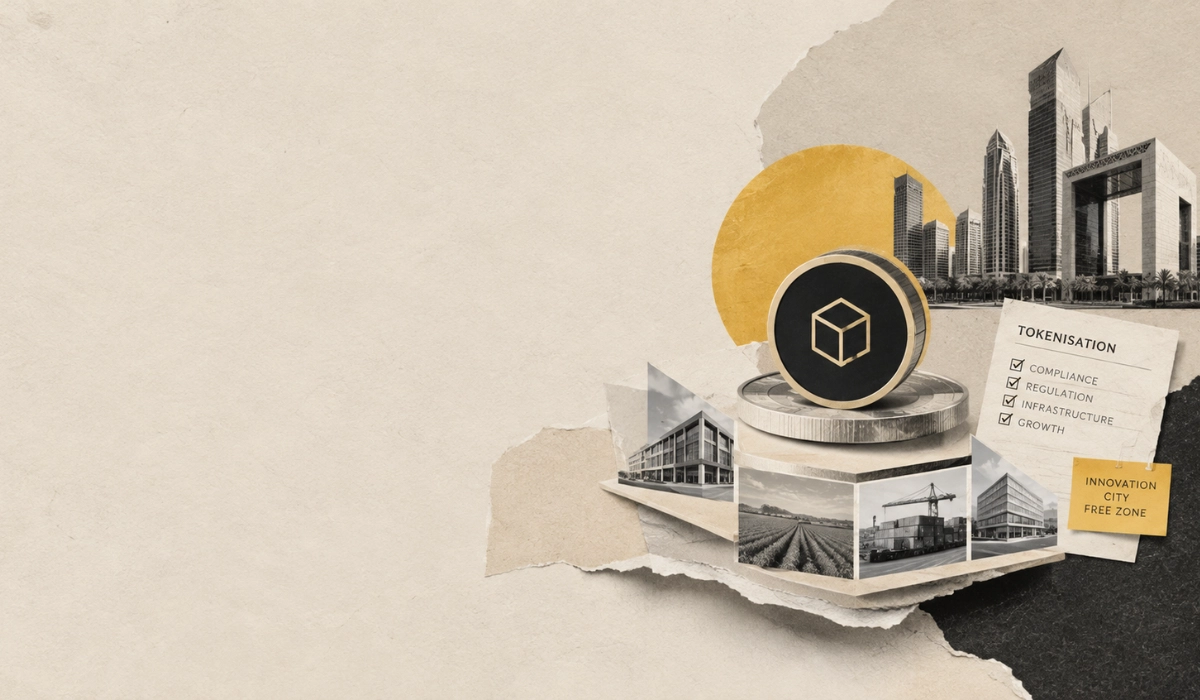
Real World Asset (RWA) tokenisation turns ownership rights in a physical or financial asset into a blockchain-based token. In the UAE, a company that provides RWA tokenisation technology and advisory services can be licensed through Innovation City Free Zone Authority in Ras Al Khaimah, one of the few UAE free zones that lists RWA tokenisation as a named licensable activity. This article explains what an RWA tokenisation company actually does, exactly what an Innovation City licence covers (and does not cover), how it compares to the other UAE pathways, and what it costs to set up.
What Is Real World Asset (RWA) Tokenisation?
RWA tokenisation is the process of representing ownership or economic rights in a real or financial asset as a digital token on a blockchain. The token encodes rights such as ownership, income entitlement, or value participation in a form that is programmable, transferable, and auditable on-chain.
Asset classes commonly tokenised include:
- Real estate: fractional ownership tokens representing a share in a property or portfolio
- Private equity and fund interests: digital representations of LP interests or company ownership stakes
- Commodities: tokenised gold, silver, agricultural commodities and energy assets
- Trade receivables and invoices: tokenised debt instruments used in supply chain finance
- Art and collectibles: digital ownership certificates for physical works
- Fixed income instruments: tokenised bonds and credit instruments
The UAE has moved from pilot projects to production volume. The Dubai Land Department activated a live secondary market for tokenised property, reaching roughly 7.8 million property tokens by February 2026. The Virtual Assets Regulatory Authority (VARA) issued its Asset-Referenced Virtual Asset (ARVA) framework for RWA tokenisation in May 2025, giving Dubai-based issuers a dedicated regulatory track. These two developments, more than general market sentiment, are why the UAE is treated as a serious jurisdiction for RWA projects rather than an experimental one.
Why Set Up an RWA Tokenisation Company in Innovation City, RAK?
Innovation City Free Zone Authority in Ras Al Khaimah licenses RWA tokenisation as a named commercial activity, covering the technology, infrastructure and advisory layer of a tokenisation project. It is the free zone rebrand of the Ras Al Khaimah Digital Assets Oasis (RAK DAO), renamed Innovation City in September 2025 under RAK Law No. 2 of 2023, and it remains one of the only UAE free zones to list RWA tokenisation by name rather than folding it into a generic “blockchain consultancy” activity.
Practical advantages of incorporating an RWA tokenisation company through Innovation City:
- A named RWA tokenisation licence activity, rather than a generic technology consultancy classification
- Access to SettleMint, a tokenisation development platform embedded in the Innovation City ecosystem, which provides licensed companies USD 250 in free platform credits and a tokenomics consultation
- Access to blockchain infrastructure partners including Hedera Hashgraph, NEAR Protocol, Avalanche and XDC Network
- Access to legal partners including NeosLegal and Legal Nodes for structuring the legal framework connecting the token to the asset
- Access to exchange partners including Binance, CoinMENA and HashKey MENA for secondary market considerations
- 0% corporate tax on qualifying free zone income, 100% foreign ownership, and typical incorporation timelines of roughly 5 to 15 working days depending on the activity and documentation required
What Does an Innovation City RWA Licence Not Cover?
This is the point every founder evaluating the zone needs to understand before applying, and it is where founders most often get the structure wrong. Innovation City Authority is a commercial free zone regulator, not a financial services regulator. It can license the technology, infrastructure and advisory work of building a tokenisation platform. It cannot, on its own, license activity that falls inside a financial regulator’s remit, including:
- Issuing tokens to the public as an investment offer
- Operating an exchange or trading venue for tokens
- Providing custody services for digital assets
- Acting as a broker-dealer
- Managing a fund or pooled investment vehicle
If a project’s token is likely to be classified as a security, or the company plans to issue tokens to public investors, operate an exchange, or provide custody, it also needs approval from the Securities and Commodities Authority (SCA), now operating federally as the Capital Markets Authority (CMA) under Decision No. 4/R.M/2026, or from VARA if the activity touches Dubai. A UAE company can, and often does, combine an Innovation City entity for the technology and IP layer with a separate CMA- or VARA-licensed entity, or an ADGM/DIFC structure, for the regulated issuance or exchange layer. Getting this split wrong is the most common reason RWA projects face bank account rejections or forced restructuring later.
Innovation City vs. VARA vs. ADGM vs. DIFC: Which UAE Jurisdiction Fits Your RWA Project?
| Jurisdiction | Regulator | Best suited for | Key limitation |
|---|---|---|---|
| Innovation City (RAK) | Innovation City Authority (commercial free zone; not a financial regulator) | Tokenisation technology, platform development, advisory, IP holding | Cannot license regulated financial activity on its own |
| Dubai mainland / Dubai free zones (excluding DIFC) | VARA | Retail-facing RWA issuance and platforms under the ARVA framework | Requires a physical Dubai office and VARA supervision fees |
| Abu Dhabi Global Market (ADGM) | Financial Services Regulatory Authority (FSRA) | Institutional securities-style tokenisation, funds | Common-law, higher compliance overhead, best for larger structures |
| Dubai International Financial Centre (DIFC) | Dubai Financial Services Authority (DFSA) | Piloting tokenised financial instruments via the DFSA sandbox | Sandbox-first; full licensing follows a separate track |
| Federal level | Capital Markets Authority (CMA, formerly SCA) | Cross-emirate virtual asset activities under Decision No. 4/R.M/2026 | Federal fee tiers apply per licensed activity |
The right structure depends on the asset type, whether the token is offered to the public, and where investors are based. This is a legal classification question, not a preference, and it should be resolved before an entity is formed rather than after.
How Does the Legal Framework Connect an RWA Token to the Underlying Asset?
A token is only as strong as the legal right it represents. Under the UAE’s current framework, RWA tokens are treated as legally distinct from security tokens, provided the underlying asset itself is not a security, which allows proportionate regulation depending on the asset class rather than a single blanket regime. That distinction determines whether a project can operate under a technology licence alone or needs a financial regulator’s approval.
For most RWA projects, this means combining a UAE entity (the Innovation City company handling the tokenisation function) with a separate legal instrument, such as an SPV, trust structure, or contractual arrangement, that documents the underlying asset’s ownership or income rights in the jurisdiction where that asset sits. Innovation City’s legal ecosystem partners, including NeosLegal and Legal Nodes, can structure this layer, and IncHub coordinates that legal framework preparation alongside company formation.
SettleMint: Innovation City’s RWA Tokenisation Platform Partner
SettleMint is an enterprise blockchain development platform available to licensed Innovation City companies at a preferential rate: USD 250 in free platform credits plus a complimentary tokenomics consultation. For an RWA tokenisation company, this provides a working environment for tokenisation smart contracts, compliance tooling and token lifecycle management without building the stack from scratch, which meaningfully shortens technical development time.
The tokenomics consultation is most useful for projects still finalising the economic design of the token: how the token’s value tracks the underlying asset, how governance rights work, and what incentives apply to different participant classes.
Which Blockchain Should You Use for RWA Tokenisation?
The right chain depends on the asset type, target market, compliance requirements and the team’s technical capability. Innovation City’s ecosystem gives direct access to:
- Hedera Hashgraph: enterprise-grade distributed ledger used by institutions for tokenisation and digital asset applications, known for speed and energy efficiency
- XDC Network: purpose-built for trade finance and cross-border RWA settlement
- Avalanche: high-performance chain with strong DeFi and institutional adoption, commonly used for tokenised funds
- NEAR Protocol: developer-friendly chain with mature tooling
Direct access to these networks’ foundation teams through Innovation City provides technical support, potential grant funding and co-marketing that an unaffiliated company would not have.
How Do RWA Tokenisation Companies Open a UAE Bank Account?
RWA tokenisation companies need banking for operational purposes: receiving fees, paying suppliers and staff, managing treasury and processing any fiat legs of tokenised asset transactions. Innovation City’s banking partners include institutions with experience assessing digital asset business models, but every application still needs to clearly explain the tokenisation model, the nature of the underlying assets, how revenue is earned, and how fiat flows move through the account. IncHub prepares this corporate profile with specific attention to how the business model is explained to the bank’s compliance team, which is consistently the deciding factor in approval.
Which Business Activities Should an RWA Tokenisation Licence Include?
The core activity is RWA tokenisation. Depending on the business model, companies commonly add:
- Token advisory and digital asset consultancy
- Blockchain and distributed ledger technology development
- Smart contract development and security auditing
- Holding investments and managing assets for the company’s own account
- Digital asset marketing and distribution
- Fintech product development and advisory
How Much Does It Cost to Set Up an RWA Tokenisation Company in Innovation City?
Innovation City’s published entry tiers (as at the time of writing) start at AED 6,600 per year with no visa allocation, rising through AED 13,200 for the Seed package (one visa), AED 15,400 for Startup, and AED 22,550 for Growth. For most single-founder RWA tokenisation companies, the Seed package is the realistic starting point. All-in first-year costs, including visas, professional fees, legal structuring, AML documentation and compliance setup, typically fall between AED 40,000 and AED 80,000 depending on project complexity. If the project also needs a CMA, VARA, ADGM or DIFC licence for a regulated activity, that carries a separate application fee, which for VARA activities alone starts at AED 40,000 and can reach AED 100,000 depending on the activity type. IncHub provides an exact breakdown for your specific structure before commitment.
Planning an RWA Tokenisation Company in the UAE?
Book a free call with an IncHub advisor. We map your tokenisation model to the right licence, split the regulated and non-regulated layers correctly, and give you a fixed-price first-year cost breakdown. No obligation.
Book a Free Consultation