
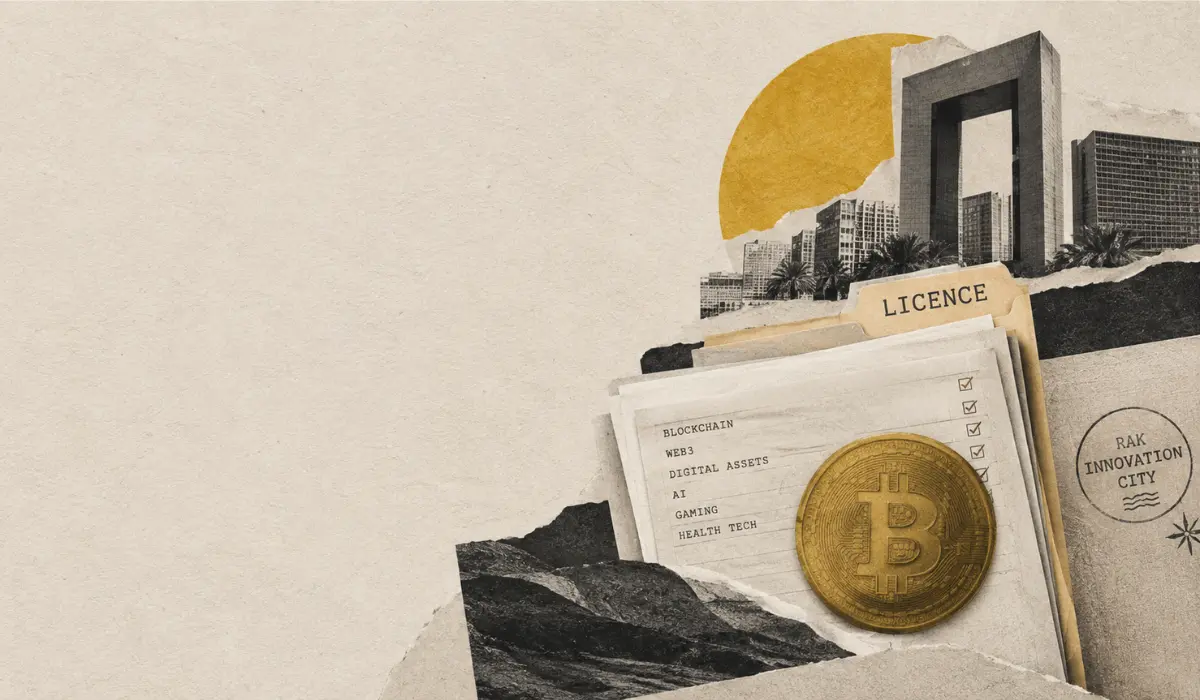
If you searched for a “RAK DAO crypto licence,” you are in the right place. In September 2025, Ras Al Khaimah Digital Assets Oasis (RAK DAO) officially rebranded to Innovation City, broadening its mandate beyond digital assets to also cover AI, gaming and iGaming, robotics, and healthtech. The free zone, the legal registration process, and the crypto and Web3 activities it licenses did not disappear. They now sit under a new name and a wider umbrella. This guide uses “Innovation City” throughout, and notes where “RAK DAO” still applies, so you can find what you need regardless of which name you searched.
Quick answer: Innovation City Free Zone Authority in Ras Al Khaimah issues trade licences for a wide range of crypto and blockchain business activities, including proprietary trading, blockchain development, token advisory, NFT platforms, Web3 infrastructure, and DAO structures. It does not issue regulated Virtual Asset Service Provider (VASP) licences for custodial exchanges, brokerage, or client-facing custody, which require approval from a financial regulator such as VARA or the SCA.
What Innovation City’s Rebrand Actually Changed
Innovation City was established under Ras Al Khaimah’s free zone legal framework as RAK Digital Assets Oasis, launched in 2023 as the world’s first free zone dedicated specifically to digital and virtual assets. In its first year, it licensed several hundred companies across blockchain, Web3, NFT, and DAO categories.
In September 2025, the authority relaunched as Innovation City, described as the world’s first AI-powered free zone, and expanded its focus to five pillars: Web3 and digital assets, artificial intelligence, gaming and iGaming, robotics, and healthtech and digital health. For crypto and blockchain founders specifically, the practical effect is limited: the same digital asset activity categories remain licensable, under the same non-regulated trade licence model, inside a larger and better-resourced free zone. If you were planning to set up under RAK DAO, you are now setting up under Innovation City, and the two terms currently refer to the same licensing pathway for crypto activities.
What Does a Crypto Licence in the UAE Actually Mean?
Quick answer: In the UAE, “crypto licence” usually means one of two very different things: a general trade licence for technology and digital asset business activities, or a regulated Virtual Asset Service Provider (VASP) licence for client-facing financial services. Innovation City issues the first type, not the second.
Understanding this distinction before you apply saves time, money, and, in some cases, a rejected application.
A general digital asset trade licence, which is what Innovation City Free Zone Authority issues for most crypto-related activities, authorises a company to conduct specific activities in the digital asset and blockchain space. It is a commercial registration, not a regulatory approval to provide regulated financial services to the public. This is the right pathway for proprietary trading firms, blockchain developers, token advisory companies, NFT platforms, Web3 infrastructure builders, DAO structures, RWA tokenisation companies, and similar technology-oriented businesses.
A regulated Virtual Asset Service Provider (VASP) licence is a separate instrument, issued by a financial services regulator, for companies providing specific financial services involving digital assets to third-party clients. This is required for custodial exchanges, broker-dealers, custody service providers, and other client-facing financial services. In the UAE this authorisation sits with regulators such as Dubai’s Virtual Assets Regulatory Authority (VARA) or, at the federal level, the Securities and Commodities Authority (SCA), depending on where and what you operate. Innovation City’s licensing does not cover this category, and no free zone trade licence substitutes for it.
Key takeaway for founders: if your business is in blockchain technology, proprietary trading, NFTs, token advisory, Web3 infrastructure, DAO operations, AI in financial services, or RWA tokenisation, a trade licence from Innovation City is what you need. If your business involves operating a custodial exchange or providing regulated custody to clients, you need a different regulatory pathway entirely, and no UAE free zone can issue that licence on its own.
Which Crypto Activities Does Innovation City License?
Innovation City Free Zone Authority licenses over 1,500 business activities in total. The categories most relevant to crypto and digital asset founders include:
- Proprietary trading in digital and virtual assets (trading own capital only)
- DAO formation, operations, and decentralised governance structures
- Non-custodial wallet development and deployment
- Blockchain and distributed ledger technology development
- Smart contract development and security auditing
- NFT creation, marketplace operations, and trading
- Token advisory and digital asset consultancy
- Real World Asset (RWA) tokenisation
- Crypto mining operations
- AI agent development and autonomous financial systems
- Web3 infrastructure and developer tooling
- Decentralised application (dApp) development
- Digital asset marketing and distribution
- Blockchain protocol development and maintenance
- Web3 gaming studio and metaverse infrastructure
Multiple activities can be combined under a single licence. A company can, for example, cover blockchain development, token advisory, and proprietary trading through one entity, without separate licences for each activity.
Innovation City vs. Other UAE Crypto Jurisdictions
Quick answer: Innovation City is the fastest and lowest-cost route to a UAE crypto trade licence for non-regulated activities. VARA (Dubai) and the SCA (federal) are the regulators you need for exchanges, custody, and brokerage. DMCC’s Crypto Centre offers Dubai’s commercial brand at a higher cost. DIFC and ADGM target regulated, institutional-grade fintech.
| Innovation City (formerly RAK DAO) | DMCC Crypto Centre | VARA (Dubai) | DIFC / ADGM | |
|---|---|---|---|---|
| What it licenses | Non-regulated crypto, Web3, blockchain, DAO, AI, gaming, robotics, healthtech activities | Non-regulated blockchain and crypto trading activities, Dubai commercial brand | Regulated VASP activities: exchange, custody, broker-dealer, advisory, lending, and more | Regulated fintech and digital asset activities under DFSA/FSRA, institutional focus |
| Typical use case | Blockchain developers, proprietary traders, token advisors, DAOs, Web3 infrastructure | Similar activities, for founders who want a Dubai-based commercial address | Exchanges, custodians, broker-dealers, and other client-facing financial services | Sophisticated financial products, institutional players, larger capital bases |
| Regulatory complexity | Low: no AML programme, compliance officer, or annual audit required for non-financial-services licences | Low to moderate | High: full financial regulator oversight, capital and substance requirements | High: capital and experience thresholds effectively filter for established players |
| Relative cost and speed | Among the fastest and lowest-cost in the UAE | Higher cost, comparable speed | Longer timeline, higher cost, reflects the regulatory scope | Longer timeline, higher capital requirements |
| Custody, exchange, or brokerage for clients | Not covered; requires VARA or SCA approval separately | Not covered by the trade licence alone | This is what VARA licenses | Covered under DFSA/FSRA regulated categories |
If your business ever plans to hold client funds, run an exchange, or offer custody to third parties, plan for that regulatory step from day one, even if you start with a non-regulated Innovation City licence for development or advisory activity. Several competitors miss this distinction; treating it clearly here is one of the reasons this guide is more reliable than most.
The Licensing Process, Step by Step
Quick answer: The process runs in five stages: defining your licensable activities, choosing a package, preparing documents, submitting the application, and completing post-incorporation setup. Standard applications are typically processed within 7 to 15 working days once the file is complete.
Blockchain-Based Licensing: Innovation City’s Distinguishing Feature
Quick answer: Innovation City operates a blockchain-based digital business identity system, giving each licensed entity a cryptographically verifiable on-chain record of its registration data, ownership, and operational status.
This means any counterparty, bank, partner, exchange, or investor can verify a company’s registration authenticity directly on-chain, without contacting the free zone authority or requesting paper certificates. For crypto and Web3 companies, whose counterparties are often on-chain-native, this is a meaningful operational advantage, and it keeps the company’s licence embedded in the same technological ecosystem its business operates in.
The DAO Association: A Purpose-Built Legal Structure
Quick answer: The DAO Association is a dedicated legal entity type for decentralised autonomous organisations, giving on-chain-governed organisations full legal personality in the UAE without forcing their governance into a conventional corporate structure.
A DAO Association under Innovation City’s framework:
- Has full legal personality in the UAE, allowing it to enter contracts, sue, and be sued
- Can open UAE business bank accounts, essential for treasury management and operational payments
- Accommodates on-chain governance without requiring governance decisions to be converted into conventional corporate resolutions
- Is governed by a charter that can reference on-chain governance mechanisms
For protocol foundations, DeFi treasury operators, DAO-governed development studios, and community-led ventures, this structure provides a legal wrapper that does not contradict the on-chain governance model.
Costs and Timelines
Published licence fees for this category of licence vary considerably across public sources, from low thousands of dirhams for a base activity registration up to tens of thousands for a fully packaged setup with visas and ancillary services. That spread reflects real differences in package tier, number of visas, activity category, and whether ancillary services (bank account support, compliance documentation, legal drafting) are bundled in, not a single “correct” number. IncHub provides a detailed, current breakdown specific to your activity and structure before any commitment is made, rather than quoting a single headline figure that may not reflect your actual requirements.
The timeline from application start to licensed company is typically 7 to 15 working days for a complete, standard file, among the fastest of any UAE digital asset or blockchain licensing pathway.
Get Your Crypto Licence Pathway Confirmed
Book a free call with an IncHub advisor. We map your activities to the right licence, confirm the package, and give you a fixed-price breakdown before anything is submitted. No obligation.
Book a Free Consultation