
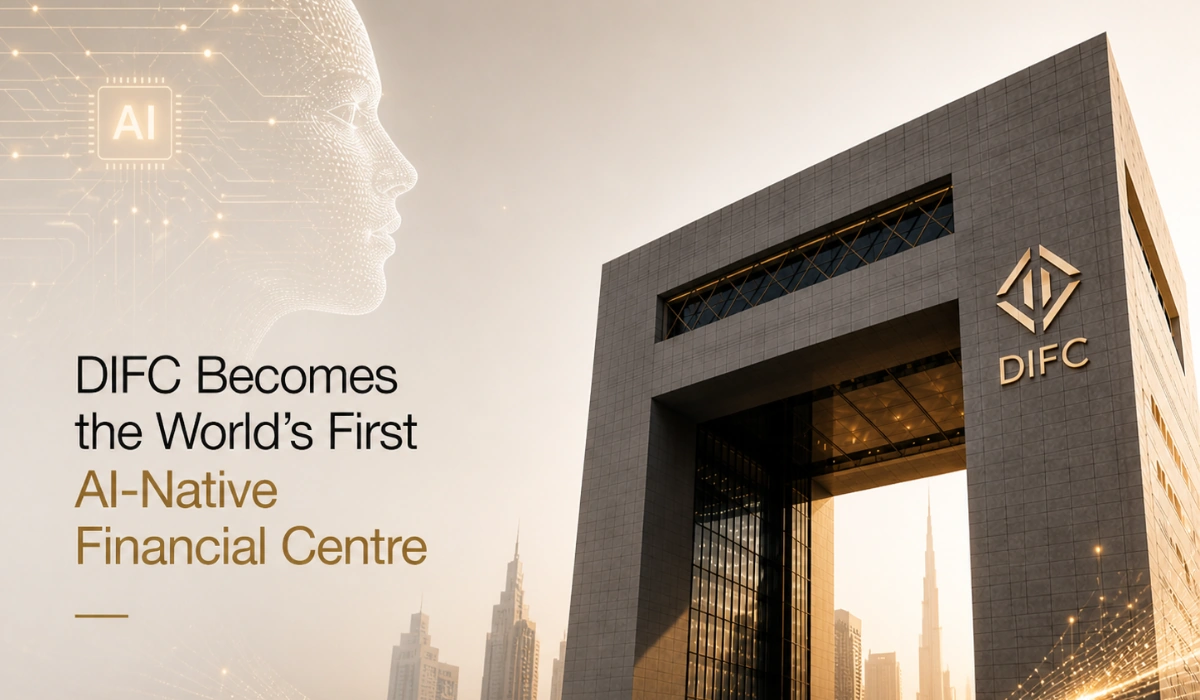
On 21 April 2026, the Dubai International Financial Centre (DIFC) announced a landmark shift in global finance. DIFC declared that it will become the world’s first AI Native financial centre. This is not about experimenting with artificial intelligence in isolated use cases. It is about embedding AI into the core structure of how a financial ecosystem is designed, regulated, and operated.
This transformation goes beyond technology adoption. DIFC is redesigning its legal frameworks, regulatory systems, business environment, talent ecosystem, and even its physical infrastructure around artificial intelligence. The programme is expected to generate AED 12.9 billion in economic value and create 25,000 jobs across AI, finance, compliance, and advanced technology roles.
For businesses already operating in DIFC, and for those evaluating a UAE setup, this development has immediate and long term implications. It changes how companies will structure operations, manage compliance, access talent, and compete in a rapidly evolving financial landscape.
What Does AI Native Actually Mean?
AI Native means artificial intelligence is built into the foundation of a system, not added later as a tool or enhancement.
Most financial centres globally are AI enabled or AI assisted. They use artificial intelligence in specific areas such as customer support chatbots, fraud detection models, or data analytics. These are layered applications placed on top of existing infrastructure.
DIFC is taking a fundamentally different approach. It is redesigning the entire ecosystem so that AI becomes part of its core architecture. This shift impacts every layer of how the financial centre operates.
1. Legal and Regulatory Frameworks
DIFC is introducing governance structures that extend beyond human activity to include AI agents, autonomous systems, and robotics. This includes ethical frameworks, accountability standards, and compliance models designed specifically for AI driven environments.
This makes DIFC one of the first jurisdictions globally to build a regulatory system that is purpose designed for AI based financial services.
2. Business Operations
Artificial intelligence will be integrated into enterprise workflows across DIFC. This includes compliance automation, financial reporting, risk monitoring, and service delivery.
Businesses operating within DIFC will benefit from faster processes, reduced operational costs, and improved accuracy. Over time, AI mediated operations are expected to become the default standard.
3. Talent Development
DIFC is investing in building a workforce that can operate effectively in an AI driven environment. This includes executive education programmes, technical certifications, and regulatory training focused on human and AI collaboration.
The goal is to create a talent pool that understands both financial systems and artificial intelligence, which is currently a gap in many global markets.
4. Ecosystem Infrastructure
DIFC is aligning its broader ecosystem with AI priorities. This includes accelerators, venture capital platforms, innovation hubs, and strategic partnerships.
The objective is to increase startup density, attract global founders, and support the creation of high growth AI driven financial companies. DIFC aims to become a global hub for AI in finance rather than just a regional centre.
5. Physical Environment
By 2030, DIFC plans to integrate AI into its physical infrastructure. This includes intelligent buildings, autonomous mobility systems, service robotics, digital twins, and smart utilities.
This will transform DIFC into a fully integrated AI enabled financial district where both digital and physical systems operate in sync.
The Scale of the Transformation
DIFC’s AI Native programme is backed by strong economic indicators and ambitious growth targets.
As of 2025, DIFC recorded:
DIFC has set a target of reaching 500 AI focused companies by 2028.
In addition, the AI Festival scheduled for 26 to 27 October 2026 at the Dubai World Trade Centre is expected to attract over 20,000 participants from more than 100 countries. This positions DIFC as a global platform for discussions around AI in finance.
The projected economic contribution of AED 12.9 billion highlights the scale of this initiative. The expected 25,000 new jobs will span AI development, data science, regulatory compliance, financial engineering, and operational support roles.
Why DIFC Has a Structural Advantage
DIFC operates under an independent legal framework based on English Common Law. It has its own courts and regulatory authority, which allows it to introduce new policies and frameworks without the delays typically seen in traditional jurisdictions.
Financial centres such as London and New York operate within complex legal systems built over decades or even centuries. This makes rapid regulatory innovation difficult.
DIFC does not face the same constraints. It can design and implement AI specific regulations more quickly and with greater flexibility.
The foundation for this transformation was established in 2023 with DIFC’s five year AI strategy, along with updates to data governance policies and data protection laws. The 2026 AI Native announcement represents the execution phase of that strategy.
The broader UAE ecosystem also supports this shift. A large portion of the working population actively uses AI, making it one of the most AI ready markets globally. This combination of regulatory flexibility and talent readiness gives DIFC a strong competitive edge.
Implications for Companies in DIFC
Financial Services Firms
Banks, asset managers, and family offices will see significant changes in how they operate. Compliance processes will increasingly be supported by AI systems. Regulatory frameworks will evolve to include AI driven decision making alongside human oversight.
Firms that begin investing in AI capabilities early will be better positioned to adapt to these changes and maintain a competitive advantage.
FinTech and Innovation Companies
DIFC is positioning itself as a global destination for AI driven financial companies. FinTech startups benefit from a supportive regulatory environment, access to capital, and a growing ecosystem of partners.
For companies building AI based financial solutions, DIFC offers one of the most advanced environments globally.
Professional Services and Holding Companies
Consultancies, law firms, and holding structures will benefit from improved efficiency through AI integration. This includes faster document processing, automated compliance, and better entity management systems.
In addition, being registered in an AI Native financial centre enhances credibility with international investors and partners.
What This Means for Founders Considering DIFC
For founders evaluating where to set up their business, DIFC’s AI Native transformation introduces several important considerations.
Regulatory Clarity
DIFC is developing clear frameworks for AI driven business models. This reduces uncertainty and makes it easier for founders to build and scale innovative solutions.
Ecosystem Access
With thousands of registered companies, active venture capital networks, and structured accelerator programmes, DIFC provides access to a high value business ecosystem.
Talent Availability
DIFC’s focus on training and certification will create a pool of professionals skilled in both finance and AI. This makes hiring more efficient for companies operating in this space.
Future Readiness
Setting up in an AI aligned jurisdiction ensures that businesses are better prepared for future regulatory and technological changes.
Cost Consideration
DIFC remains a premium jurisdiction in the UAE. Setup costs typically range between AED 110,000 and AED 290,000 depending on the licence type and business activity.
While the cost is higher than some alternatives, the long term value is stronger for financial services and AI driven companies.
DIFC vs ADGM: A Practical Comparison
Abu Dhabi Global Market (ADGM) is another leading financial free zone in the UAE. It offers a strong regulatory framework, lower setup costs, and a well established reputation.
However, DIFC’s AI Native transformation gives it a clear advantage in areas related to AI driven finance and innovation.
DIFC is better suited for companies where AI is a core part of the business model. ADGM remains a strong option for traditional financial structures such as wealth management firms and family offices.
FAQ
When will AI be fully implemented in DIFC?
The transformation is being rolled out in phases. Core regulatory and operational systems are already evolving from 2026. Full integration of physical infrastructure is expected by 2030.
Will existing licences be affected?
No. Existing licences will remain valid. The AI Native framework will be introduced alongside current systems rather than replacing them.
How can businesses set up in DIFC?
Businesses can work with advisory firms to manage the entire setup process, including licence selection, regulatory approvals, and compliance requirements.
Conclusion
DIFC’s move to become an AI Native financial centre represents a major shift in the global financial landscape. It redefines how financial ecosystems are built by placing artificial intelligence at the core rather than treating it as an add on.
For businesses, this creates both opportunities and strategic decisions. Companies that align early with AI driven systems and operate within forward looking jurisdictions like DIFC will be better positioned for long term growth and competitiveness.
This is not just a regional development. It signals the direction in which global finance is moving.
Sources: