
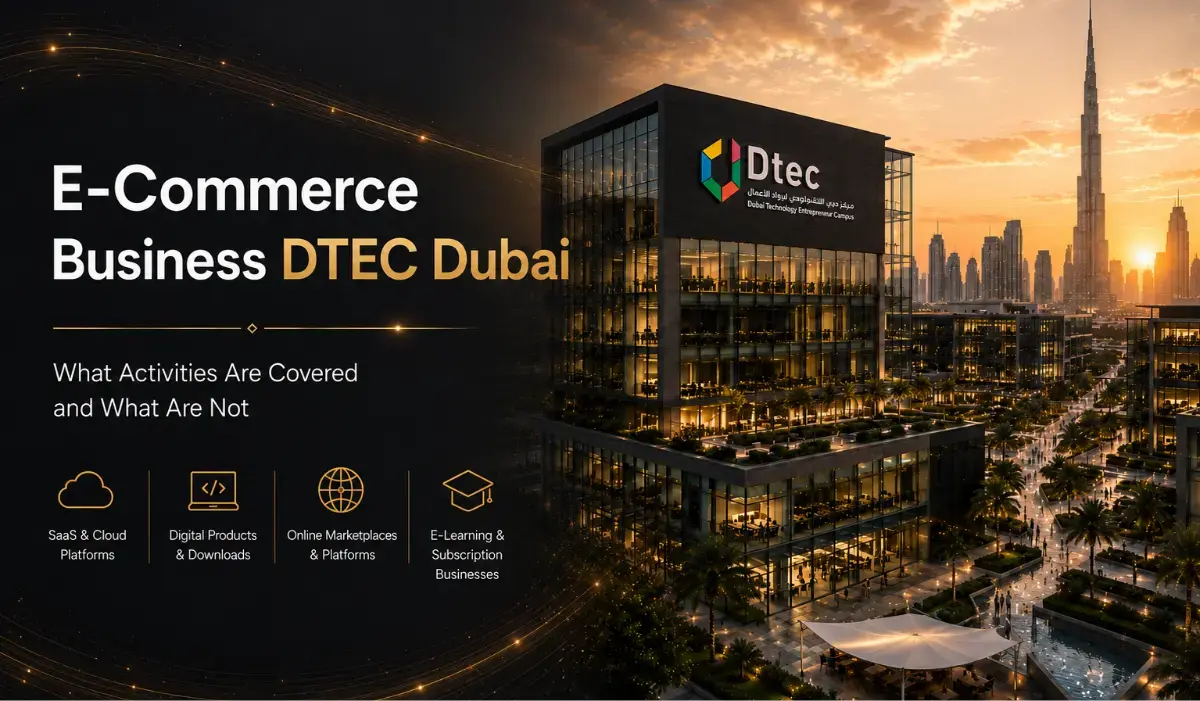
Setting up an e-commerce business in DTEC Dubai has become a popular choice for startups and digital entrepreneurs entering the UAE market. Dubai continues to position itself as a global hub for digital trade, innovation, and technology-driven businesses, making free zones like DTEC attractive for early-stage companies.
However, many founders misunderstand what an e-commerce business DTEC Dubai license actually allows. While the term “e-commerce” suggests online selling in general, DTEC is not designed for traditional retail or logistics-based online stores.
Instead, it is built for technology-enabled commerce businesses, including platforms, software, and digital products.
This article explains in detail what you can and cannot do under a DTEC e-commerce structure, along with better alternatives if your business involves physical goods.
What Is an E-Commerce Business in UAE Licensing Terms?
In the UAE, an e-commerce business DTEC Dubai model is not treated as a single category. Instead, it is divided based on operational activity.
The UAE authorities distinguish between:
This classification is important because licensing depends on what you sell and how it is delivered, not just whether the business operates online.
DTEC falls under the technology and digital services ecosystem, meaning it primarily supports digital commerce innovation rather than physical trade.
Is an E-Commerce Business Allowed in DTEC Dubai?
Yes, but with limitations.
A DTEC e-commerce business Dubai license is specifically designed for companies that build or enable digital commerce systems rather than operate retail stores.
In simple terms:
This distinction is critical when choosing the right UAE free zone for your business model.
What Activities Are Allowed for an E-Commerce Business in DTEC Dubai?
1. Digital Product E-Commerce
One of the strongest use cases for an e-commerce business DTEC Dubai setup is digital product distribution.
This includes:
These models fall under digital commerce services, which align perfectly with DTEC’s technology framework.
2. E-Commerce Platform and Technology Development
DTEC is particularly well-suited for companies building the infrastructure behind e-commerce.
Typical activities include:
This makes DTEC a strong hub for e-commerce technology companies in Dubai, not retail sellers.
3. Dropshipping
Dropshipping is often associated with e-commerce businesses in Dubai, but in DTEC it is allowed only under strict conditions.
A DTEC e-commerce business Dubai dropshipping model is only viable if:
While this model appears simple, it requires careful planning due to VAT classification, cross-border compliance, and customs considerations.
What Is NOT Allowed in a DTEC E-Commerce Business?
Despite its flexibility in digital commerce, DTEC does not support physical goods trade.
A DTEC e-commerce business licence does not permit the following activities:
- Importing goods into the UAE for resale
- Storing inventory in warehouses
- Operating fulfilment or logistics centres
- Running courier or delivery services
- Re-exporting physical goods from the UAE
- Retail trading of physical products online
These activities fall under commercial trading licenses or logistics-focused free zones, not technology-based free zones.
UAE Free Zone Alternatives for Physical E-Commerce
If your business involves physical products, DTEC is not the correct structure. Instead, consider the following UAE free zones:
Dubai CommerCity
A dedicated e-commerce free zone designed for:
- End-to-end online retail operations
- Integrated logistics and fulfilment
- International e-commerce brands entering the GCC market
JAFZA (Jebel Ali Free Zone)
Best suited for:
- Import/export businesses
- Large-scale warehousing and distribution
- Global supply chain operations
Mainland Dubai
Ideal for:
- Direct sales within the UAE market
- Hybrid online and offline retail models
- Businesses requiring full commercial trading flexibility
Key Considerations for E-Commerce in DTEC
One of the most overlooked aspects of an e-commerce business DTEC Dubai setup is regulatory compliance. Even if your business is digital, you must ensure proper classification of your activities.
1. VAT Compliance
2. Cross-Border Transactions
If your business sells digital products globally, you must ensure:
3. Business Activity Alignment
Misclassifying a physical trading model as a digital business can lead to:
This is why choosing the correct free zone is as important as the business idea itself.
UAE E-Commerce Market Overview
The UAE continues to be one of the fastest-growing digital commerce markets in the region. An e-commerce business DTEC Dubai setup benefits from being located in one of the most digitally advanced economies globally.
Key growth drivers include:
Dubai also serves as a strategic hub connecting Asia, Europe, and Africa, making it ideal for scaling digital commerce platforms internationally.
Why DTEC Is Ideal for Digital E-Commerce Startups
A properly structured e-commerce business DTEC Dubai company offers several advantages for tech entrepreneurs:
However, it is important to understand its limitation: it is not a trading free zone.
Final Thoughts
An e-commerce business setup is best suited for entrepreneurs building digital commerce ecosystems such as SaaS platforms, online marketplaces, and digital product businesses.
However, it is not designed for physical retail or logistics-driven e-commerce models.
Understanding this distinction early helps ensure compliance, avoids licensing issues, and allows you to choose the right UAE free zone for long-term scalability.
Frequently Asked Questions
Can I sell physical products using an e-commerce business DTEC Dubai licence?
No. Physical goods trading requires a commercial or trading licence in a suitable free zone or mainland setup.
Is DTEC suitable for starting an online store?
Yes, but only for digital products, services, and platform-based e-commerce models.
Can I operate Amazon UAE from DTEC?
Only for digital or service-based products. Physical goods require import and fulfilment licensing
Do I need VAT registration for a DTEC e-commerce company?
Yes, VAT registration is required if your taxable turnover exceeds AED 375,000 in a 12-month period. Even for digital businesses, VAT applies to UAE-based customers at the standard 5% rate. International sales may be treated differently depending on classification and tax rules.
Which UAE free zone is best for full-scale e-commerce?
Dubai CommerCity is the most suitable option for logistics-heavy and product-based e-commerce businesses.
Need Help Setting Up in DTEC Dubai?
Choosing the right structure for your e-commerce business DTEC Dubai setup is crucial for compliance and growth.