
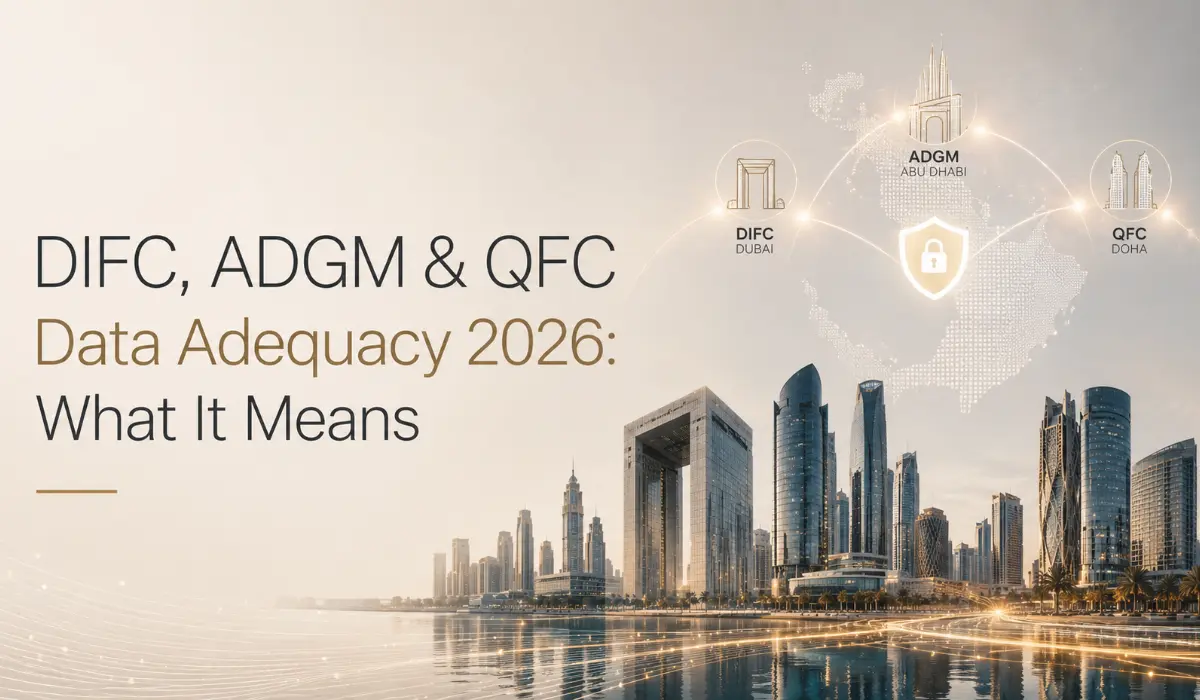
The Qatar Financial Centre (QFC), Dubai International Financial Centre (DIFC), and Abu Dhabi Global Market (ADGM) have formally recognised each other’s data protection regimes as adequate. This is a major development for businesses operating across the Gulf’s leading financial centres.
As a result, personal data can now move between these jurisdictions without requiring additional transfer mechanisms such as Standard Contractual Clauses (SCCs), Binding Corporate Rules (BCRs), or regulator-specific approvals. For financial institutions, family offices, fintech companies, and regional corporate groups, this significantly reduces compliance friction and improves operational efficiency.
The decision also signals a broader trend toward regulatory alignment across the Gulf, particularly in areas such as digital regulation, AI governance, ESG reporting, and financial services compliance.
DIFC, ADGM and QFC Now Recognise Each Other’s Data Protection Frameworks
On 29 January 2026, the QFC, DIFC, and ADGM formally approved mutual adequacy recognition between their respective data protection regimes. This followed detailed assessments of each jurisdiction’s legal framework, enforcement capability, and alignment with international best practices in privacy and data governance.
Each authority concluded that the others maintain a high-standard regulatory framework incorporating:
The adequacy recognition was granted because all three jurisdictions met what regulators considered a “best-in-class” benchmark for data protection standards.
Practical Example of the Change
A DIFC-licensed asset manager transferring client information to an ADGM-regulated adviser, or to a QFC-based fund administrator, no longer needs SCCs or similar transfer arrangements for that specific flow.
The transfer is now treated similarly to a domestic transfer within an approved jurisdictional ecosystem.
Why the DIFC, ADGM and QFC Adequacy Decision Matters
The mutual recognition framework has important operational and strategic implications for businesses operating across the UAE and wider Gulf region.
Reduced Compliance Burden for Cross-Border Data Transfers
Businesses transferring data between DIFC, ADGM, and QFC no longer need to maintain separate contractual transfer mechanisms solely for these jurisdictions.
This materially reduces administrative overhead for legal, risk, and compliance teams. Organisations can redirect resources away from repetitive documentation exercises and toward substantive risk management and governance.
Stronger Case for Regional UAE and Qatar Structures
Multinational financial groups can now operate more efficiently using hub-and-spoke regional models.
For example, a group headquartered in DIFC can maintain operational teams in ADGM while using Qatar as a booking or servicing centre without implementing complex legal workarounds for every intra-group data transfer.
This creates greater flexibility for regional structuring decisions.
Improved Efficiency for Family Offices and Private Wealth Structures
Ultra-high-net-worth (UHNW) families frequently operate structures spanning multiple Gulf financial centres, including foundations, SPVs, investment vehicles, and holding entities.
The adequacy framework allows governance information, beneficial ownership records, investment reporting, and operational data to move more efficiently between DIFC, ADGM, and QFC entities.
This supports better centralisation and coordination across family-office operations.
Fintechs and Service Providers Gain Operational Scale
Fintech businesses, cloud-based service providers, KYC platforms, tokenisation providers, and outsourced operational vendors benefit significantly from the reduced transfer complexity.
A single regional infrastructure can now support multiple Gulf financial centres more efficiently, helping providers scale operations while simplifying compliance management.
Regulatory Convergence Across Gulf Financial Centres Is Accelerating
The adequacy decision is also strategically important because it reflects growing regulatory coordination between the Gulf’s leading common-law financial centres.
Rather than competing through fragmented frameworks, DIFC, ADGM, and QFC are increasingly aligning around international standards.
This trend is likely to continue in areas including:
What the Mutual Adequacy Recognition Does Not Change
Although the decision simplifies many intra-Gulf transfers, several important compliance obligations remain fully applicable.
Transfers Outside DIFC, ADGM and QFC Still Require Legal Basis
Data transfers to mainland UAE, mainland Qatar, or international jurisdictions outside the recognised framework still require a lawful transfer mechanism under the applicable legislation, including UAE Federal Decree-Law No. 45 of 2021 and related regulations.
The adequacy recognition applies only between DIFC, ADGM, and QFC.
Sector-Specific Rules Continue to Apply
Industry-specific obligations remain unaffected by the adequacy framework.
This includes requirements relating to:
Businesses must still comply with all applicable sectoral requirements.
Data Subject Rights Remain Fully Enforceable
The adequacy decision concerns transfer mechanisms only. It does not reduce or alter underlying privacy rights.
Individuals continue to retain rights relating to:
Onward Transfers Still Require Compliance Review
If a DIFC entity receives data originating from QFC and subsequently transfers that data to a non-adequate third country, the onward transfer must still comply with the applicable international transfer rules.
Businesses should therefore continue monitoring downstream transfer pathways carefully.
Practical Action Checklist for Businesses
Organisations operating across DIFC, ADGM, and QFC should review their data governance frameworks promptly to take advantage of the new regime.
For Data Protection Officers and Compliance Teams
For Regional Corporate Groups
For Family Offices
For New Market Entrants
The adequacy framework strengthens the case for establishing a regional Gulf hub in DIFC, ADGM, or QFC.
Businesses can now make jurisdictional decisions based more heavily on substantive factors such as:
Data-transfer friction is now significantly less of a differentiating factor between these centres.
Recommended Next Steps for Businesses
Over the next 90 days, organisations should refresh their cross-border data flow inventories and reassess legacy transfer arrangements.
Many businesses are currently maintaining SCCs and related transfer artefacts that may no longer be necessary for transfers between DIFC, ADGM, and QFC.
Removing redundant mechanisms can reduce operational drag, simplify governance processes, and create opportunities for structural consolidation.
For businesses planning new regional structures, the adequacy framework should now form part of the jurisdictional analysis from the outset.
Frequently Asked Question
What does the DIFC, ADGM, and QFC data adequacy decision mean
DIFC, ADGM, and QFC now recognise each other’s data protection frameworks as adequate. This allows personal data to move between these financial centres without extra transfer agreements like SCCs or BCRs.
How does the new adequacy framework benefit businesses operating across the Gulf?
The new framework makes it easier for companies to share personal data between DIFC, ADGM, and QFC without using additional transfer agreements. This reduces administrative work and allows businesses to manage regional operations more efficiently.
Do companies still need to follow data protection rules after the adequacy decision?
Yes, businesses must still comply with privacy laws, data security requirements, and data subject rights. The new framework only simplifies data transfers between DIFC, ADGM, and QFC.
Why is the DIFC, ADGM, and QFC adequacy recognition important for financial and fintech companies?
Financial institutions, fintech firms, and family offices often transfer data across multiple Gulf financial centres. The new framework makes cross-border operations smoother and supports more efficient regional expansion.
Sources: