
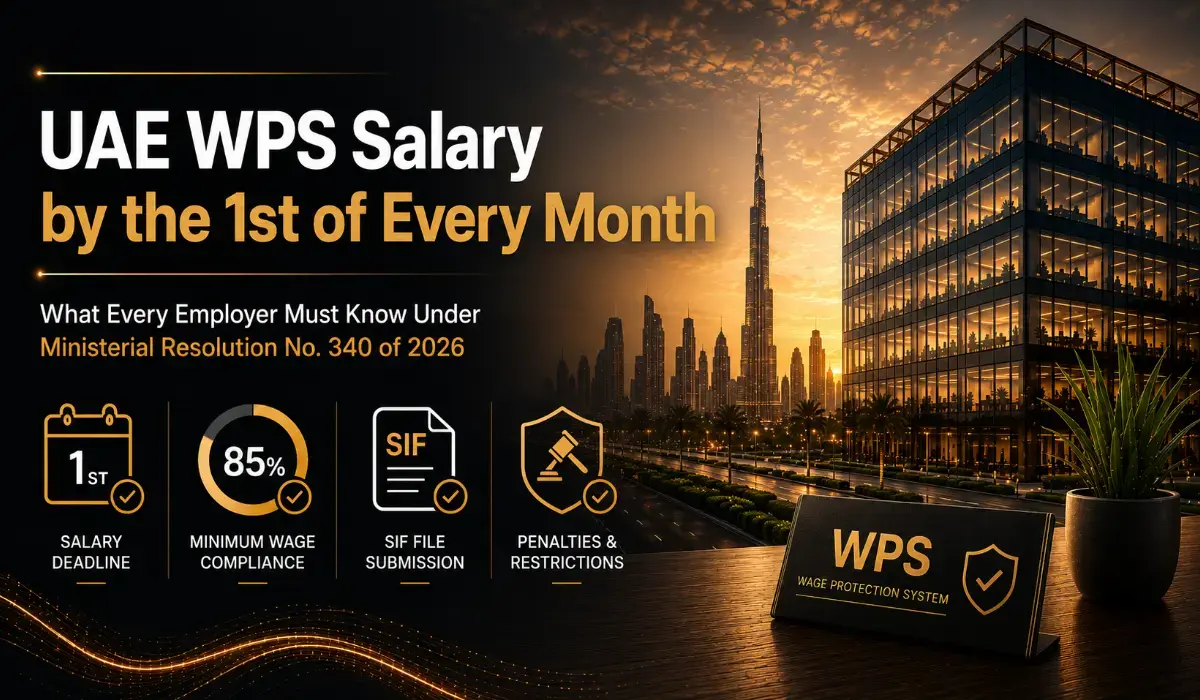
The UAE has introduced stricter payroll compliance requirements that affect every private sector employer registered with the Ministry of Human Resources and Emiratisation (MOHRE). Effective 1 June 2026, Ministerial Resolution No. 340 of 2026 requires salaries to be processed through the Wage Protection System (WPS) by the first day of every Gregorian month, replacing the previous payment timeline.
The updated framework places greater emphasis on timely salary payments, automated compliance monitoring, and employer accountability. Businesses that continue following older payroll schedules may face work permit restrictions, financial penalties, and other enforcement measures.
This guide explains how the new UAE WPS salary rules work, the changes employers need to know, practical steps to stay compliant, and the impact of missing the revised deadline.
Direct Answer
From 1 June 2026, all MOHRE-registered private sector employers must pay salaries through the UAE Wage Protection System (WPS) by the first day of each Gregorian month. Employers must transfer at least 85% of total wages due on time, with any unpaid balance supported by legally permitted deductions. Failure to comply may result in automated enforcement, including work permit restrictions, fines, and labour disputes.
What is the UAE Wage Protection System (WPS)?
The Wage Protection System (WPS) is an electronic salary transfer system introduced by MOHRE in partnership with the Central Bank of the UAE. It ensures employees in the private sector receive their salaries accurately and on time through authorised banks, exchange houses, and financial institutions.
Instead of paying salaries manually or in cash, employers upload a Salary Information File (SIF) containing employee wage details. Once approved, salaries are transferred electronically through authorised WPS agents, creating a secure and transparent payroll record for both employers and government authorities.
The system benefits employers and employees alike.
For employers, WPS simplifies payroll administration, creates a documented payment history, and demonstrates compliance with UAE labour regulations.
For employees, it provides greater transparency, ensures wages are paid according to employment contracts, and reduces the risk of salary delays or disputes.
Today, the Wage Protection System WPS is one of the UAE’s key labour compliance frameworks, helping strengthen employee protection while promoting accountability across the private sector.
Who Must Comply with the WPS Salary System?
The updated WPS salary system applies to most MOHRE-registered private sector establishments operating in the UAE.
Businesses that typically fall within the scope of WPS include:
- Mainland companies registered with MOHRE
- Limited Liability Companies (LLCs)
- Branch offices of foreign companies registered with MOHRE
- Commercial, industrial, and service businesses employing staff under UAE Labour Law
Some free zone companies also fall under WPS if their employees are regulated by MOHRE. However, certain financial free zones and jurisdictions with independent employment regulations may follow separate payroll requirements.
If your business operates within a free zone, confirm whether your employees are registered under MOHRE before determining your WPS obligations.
What Changed Under Ministerial Resolution No. 340 of 2026?
The latest Resolution fundamentally changes how employers manage payroll.
Under the previous framework, businesses had additional time after month-end to finalise attendance records, calculate overtime, approve deductions, generate payroll files, and transfer salaries. Many organisations built their payroll cycle around this schedule.
The new regulation removes that flexibility.
Employers are now expected to complete payroll processing before the month ends so salaries are transferred through WPS by the first day of the following month. At the same time, the minimum compliance threshold has increased from 80% to 85%, new employees fall within WPS requirements from their first day of employment, and enforcement is now driven by automated monitoring rather than employee complaints.
The following comparison highlights the most important changes.
|
Requirement |
Previous Rule (Resolution 598 of 2022) |
Current Rule (Resolution 340 of 2026) |
|
Salary payment deadline |
By the 10th day of the following month |
By the 1st day of every Gregorian month |
|
Grace period |
15-day grace period before enforcement |
No grace period |
|
Compliance threshold |
80% of wages paid on time |
85% of wages paid on time |
|
New employee coverage |
30-day exemption |
Covered from the first day of employment |
|
Labour dispute process |
Employee generally initiated complaints |
MOHRE can automatically register disputes after continued non-compliance |
|
Compliance monitoring |
Primarily complaint-based |
Automated digital monitoring through WPS |
These changes require businesses to review their payroll process from start to finish. Attendance cut-off dates, payroll approvals, bank funding, and SIF submission timelines should all be brought forward to ensure salaries reach employees on time every month.
Employers that continue following the previous payroll cycle risk avoidable compliance failures, even if salary payments are delayed by only a few days.
WPS Enforcement Timeline: What Happens If Salaries Are Paid Late?
One of the biggest changes introduced under Ministerial Resolution No. 340 of 2026 is the shift to an automated enforcement model. Once the salary payment deadline passes, MOHRE’s digital monitoring systems begin tracking compliance without waiting for an employee to file a complaint.
This means employers have far less time to correct delayed payments. What was previously a manageable delay can now quickly lead to operational restrictions that affect hiring, workforce management, and business continuity.
The enforcement process follows a structured timeline.
|
Timeline |
Action |
Impact on the Business |
|
Day 1 |
Salary must be transferred through WPS. |
Any unpaid salary is immediately recorded as overdue. |
|
Day 2 |
Automated compliance alert issued. |
A formal warning is recorded against the employer. |
|
Day 5 |
Work permit services suspended. |
New work permits, renewals, and transfers may be restricted until outstanding salaries are paid. |
|
Day 11 |
Administrative penalties apply. |
The company may face fines and be downgraded to MOHRE Category 3, resulting in higher government service fees and compliance restrictions. |
|
Day 16 |
Labour disputes may be registered automatically. |
Employees may be able to transfer to another employer under applicable regulations, while MOHRE begins the dispute process. |
|
Day 21 |
Referral to the Public Prosecution |
Continued non-compliance can lead to legal action and additional enforcement measures under UAE law. |
While the timeline is clear, businesses should avoid relying on it as a grace period. The safest approach is to ensure salaries are processed before the deadline rather than attempting to resolve delays after enforcement has already begun.
Why the New Salary Deadline Is More Challenging Than It Appears
At first glance, moving the salary deadline from the 10th of the month to the 1st may seem like a simple administrative change. In practice, it requires employers to redesign their entire payroll process.
Previously, payroll teams had several days after month-end to reconcile attendance, approve overtime, verify deductions, prepare payroll, generate the Salary Information File (SIF), secure management approvals, and fund payroll accounts.
Those activities now need to be completed before the new month begins.
Businesses that continue following their previous payroll schedule risk missing the WPS deadline, even if payroll calculations are accurate. Delays often occur because attendance corrections, leave approvals, bonus calculations, or bank funding are left until the final days of the month.
The revised WPS salary system encourages employers to adopt earlier payroll cut-off dates, automate manual processes where possible, and improve coordination between HR, finance, and payroll teams.
For businesses with a large workforce or multiple branches, these operational improvements are no longer optional. They are essential for maintaining uninterrupted compliance.
Five Practical Steps to Stay Compliant with the UAE WPS Salary Rules
Meeting the new salary deadline requires planning throughout the month rather than rushing payroll at the end. Employers can reduce compliance risks by adopting a structured payroll process.
1. Bring Forward Your Payroll Cut-Off Date
Waiting until the final days of the month to approve attendance or overtime leaves little room to resolve discrepancies. Set an internal payroll cut-off around the 25th of each month to allow sufficient time for payroll review and WPS processing.
2. Fund Payroll Accounts Before Month-End
Even when payroll calculations are complete, salary payments can still be delayed if funds are transferred too late. Ensure payroll accounts are funded several days before salaries are due, particularly during months with public holidays or weekends.
3. Automate Salary Information File (SIF) Generation
Many payroll delays result from manual spreadsheet preparation and data entry errors. Payroll software that automatically generates compliant Salary Information Files (SIF) reduces processing time, improves accuracy, and minimises last-minute corrections.
4. Maintain Proper Documentation for Salary Deductions
The updated regulations allow a portion of unpaid wages only where deductions are legally permitted and properly documented. Maintain signed employee agreements and supporting records for any deductions relating to advances, loans, accommodation, or other authorised arrangements.
5. Plan Ahead for High-Risk Payroll Months
Public holidays, Eid celebrations, long weekends, and month-end bank closures can delay payroll processing if businesses wait until the last minute. Review the annual calendar in advance and schedule payroll activities earlier during these periods to ensure salaries reach employees on time.
Employers that build these practices into their monthly payroll cycle are far better positioned to comply with the updated UAE WPS salary requirements while reducing administrative pressure on HR and finance teams.
Which Businesses Are Most Affected by the New WPS Rules?
The revised Wage Protection System (WPS) applies to all MOHRE-registered private sector employers, but some industries face greater operational challenges due to their workforce size, payroll complexity, or reliance on manual processes.
Businesses in the following sectors should review their payroll procedures immediately:
- Construction
- Transport and logistics
- Security services
- Cleaning and facility management
- Recruitment agencies
- Manufacturing
- Hospitality
These industries often manage large workforces, variable attendance, overtime, shift allowances, or multiple payroll cycles. Even small delays in attendance reconciliation or payroll approvals can increase the risk of missing the WPS deadline.
Small and medium-sized enterprises (SMEs) also face unique challenges. Many rely on spreadsheets or basic accounting software instead of dedicated payroll systems, making it more difficult to prepare accurate Salary Information Files (SIF) and complete salary transfers before the first day of the month.
Regardless of company size or industry, reviewing payroll workflows, approval processes, and funding timelines is now an essential part of maintaining compliance.
Frequently Asked Questions
What happens if the 1st falls on a weekend or public holiday?
The salary payment deadline remains the same. Employers should process payroll early enough to ensure salaries are credited through WPS by the required date. Where banking holidays may affect processing times, submitting the Salary Information File (SIF) on the last working day of the previous month is considered best practice.
Does the new WPS rule apply to free zone companies?
It depends on the free zone.
The updated regulation applies to businesses registered with MOHRE. Some free zone companies also fall under MOHRE for labour and visa administration, while others operate under independent employment regulations with separate payroll procedures. Employers should confirm which labour authority governs their employees before determining their WPS obligations.
What is a Salary Information File (SIF)?
A Salary Information File (SIF) is the electronic payroll file employers submit through the Wage Protection System. It contains employee salary details, including wages, allowances, deductions, and payment information.
Banks and authorised exchange houses use the SIF to process salary payments, while MOHRE uses it to monitor employer compliance with WPS regulations.
What happens if my company misses the salary deadline?
Late salary payments may trigger an automated compliance process that begins with a formal warning and can escalate to work permit restrictions, administrative penalties, labour dispute registration, and legal action if the issue remains unresolved.
Employers should investigate and resolve payment delays immediately rather than waiting for enforcement measures to progress.
Can salaries be processed before the 1st of the month?
Yes. In fact, many businesses now process payroll on the final working day of the previous month to account for bank processing times and reduce the risk of delayed salary transfers.
Early processing has become a recommended best practice under the updated WPS salary system.
Final Thoughts
The updated UAE WPS salary rules represent more than a revised payment deadline. They require employers to rethink how payroll is planned, approved, and processed each month.
Businesses that continue relying on the previous payroll cycle risk work permit restrictions, financial penalties, and operational disruptions. Those that modernise their payroll processes, automate WPS reporting, and prepare salaries before month-end will be better positioned to remain compliant while maintaining employee confidence and business continuity.
Rather than viewing the new requirements as another regulatory obligation, employers should treat them as an opportunity to strengthen payroll governance and reduce compliance risks across the organisation.
How IncHub Can Help
Keeping up with changing payroll regulations can be challenging, particularly for growing businesses managing visas, labour compliance, and monthly payroll together.
At IncHub Corporate Services, we help businesses navigate every stage of Wage Protection System (WPS) compliance, from MOHRE registration and establishment card services to payroll coordination, SIF implementation, PRO services, and ongoing labour compliance support.
Whether you’re setting up a new company, reviewing your existing payroll process, or preparing for the latest UAE WPS salary requirements, our team can help you build a compliant and efficient payroll framework that supports long-term business operations.
Contact IncHub today to ensure your business remains compliant with the latest UAE WPS regulations while focusing on growth with confidence.
Verified Sources and References
1. Morgan Lewis – UAE Introduces New Wage Protection System Resolution Effective 1 June 2026 (May 2026)
2. Gulf News – UAE Sets Monthly Salary Deadline for Private Sector from June 2026 (May 2026)
3. Khaleej Times – UAE New Salary Payment Rule Explained (June 2026)
4. TrueBays – New UAE WPS Salary Rules 2026: The 1st-of-the-Month Mandate Explained (June 2026)
5. Hussain Al Shemsi CA – UAE New Salary Rule June 2026 (May 2026)
6. Arabian Business – UAE Salary Rules: Payroll Activity Jumps 151% (June 2026)
7. Greythr – UAE New WPS Rules 2026 (June 2026)
8. Sarmat – UAE New Salary Laws 2026 (June 2026