
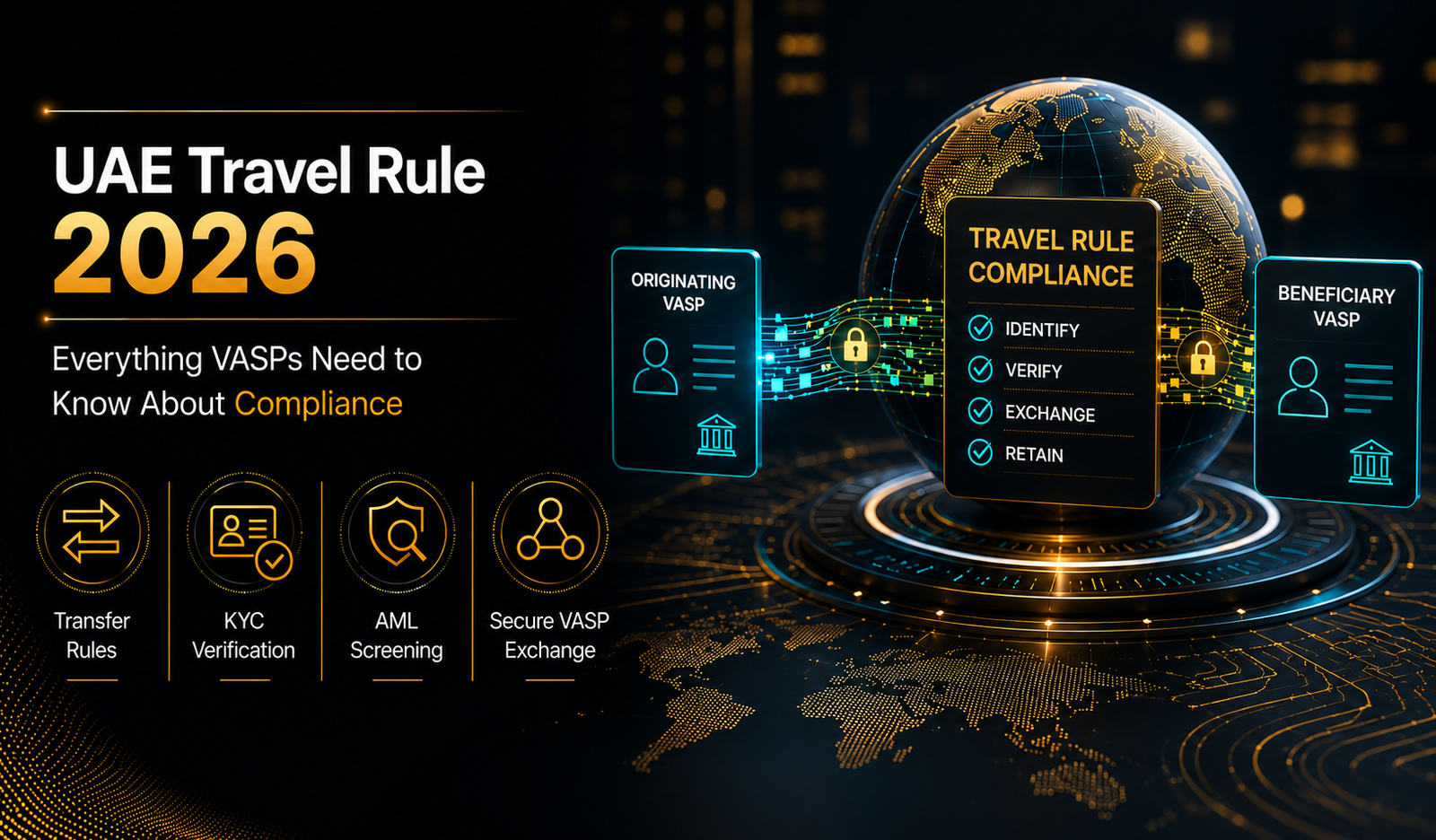
Every virtual asset transfer carries a traceable flow of value, but blockchain records alone do not reveal the identity of the parties involved. This gap increases exposure to money laundering, terrorist financing, and sanctions evasion risks. The UAE Travel Rule addresses this by requiring licensed Virtual Asset Service Providers (VASPs) to collect, verify, and securely exchange information about both the sender and recipient of qualifying transactions. Under VARA, ADGM, and DFSA frameworks, it forms part of broader AML obligations assessed through governance, due diligence, and monitoring standards. VASPs must determine applicability, ensure secure data exchange, manage self-hosted wallet risks, and maintain audit-ready compliance records across all virtual asset transfers.
Direct Answer
The UAE Travel Rule requires licensed Virtual Asset Service Providers to collect, verify, retain, and, where applicable, exchange information about the sender and recipient of qualifying virtual asset transfers. While the core requirement follows international FATF standards, implementation differs across UAE regulators. VARA applies a transaction threshold, whereas ADGM requires Travel Rule compliance for every transfer. Businesses must also maintain appropriate controls for customer due diligence, record keeping, sanctions screening, and risk management.
Key Takeaways
UAE Travel Rule Requirements by Regulator
Although the Travel Rule is recognised across the UAE’s virtual asset regulatory framework, the compliance obligations are not identical. Each regulator applies the rule within its own licensing framework, meaning VASPs must understand the expectations of the authority supervising their business.
The table below highlights the key differences.
|
Regulator |
Jurisdiction |
When the Travel Rule Applies |
Key Compliance Expectations |
|
VARA |
Dubai (excluding DIFC) |
Virtual asset transfers of AED 3,500 or more, including linked transactions that exceed the threshold |
Collect and verify required customer information, transmit Travel Rule data where applicable, maintain records, apply enhanced due diligence for higher-risk transactions, and comply with AML monitoring requirements. |
|
ADGM FSRA |
Abu Dhabi Global Market |
All virtual asset transfers, regardless of transaction value |
Perform customer due diligence, exchange originator and beneficiary information, maintain transaction records, and apply risk-based AML controls for every transfer. |
|
DFSA |
Dubai International Financial Centre |
In line with AML obligations and FATF standards |
Maintain systems and controls capable of identifying, assessing, and monitoring virtual asset transfers while meeting AML and sanctions compliance requirements. |
|
Federal AML Framework |
UAE-wide |
Applies alongside sector-specific regulations |
Requires VASPs to implement effective AML, CTF, customer due diligence, record-keeping, and reporting controls as part of their overall compliance programme. |
Although the thresholds differ, the objective remains consistent across all regulators: improve transparency, reduce financial crime risks, and ensure licensed VASPs can demonstrate effective compliance throughout the lifecycle of a virtual asset transfer.
What Information Must Be Collected?
The Travel Rule is centred on one principle: both the sending and receiving VASP should have sufficient information to understand who is involved in a transaction before the transfer is completed.
Depending on the transaction and the applicable regulatory framework, the following information is generally required.
Originator Information
The originating VASP should collect and verify information relating to the sender, including:
This information enables the receiving institution to assess whether the transaction presents any sanctions, fraud, or financial crime risks.
Beneficiary Information
Information relating to the recipient typically includes:
Before releasing the transferred assets, the receiving VASP should use this information to complete sanctions screening and any additional risk assessments required under its compliance framework.
Why Accurate Data Matters
Incomplete or inaccurate customer information can create significant compliance risks.
For example, if a receiving VASP cannot verify the beneficiary or identify the originating institution, it may delay the transaction, request additional information, or reject the transfer altogether.
Maintaining accurate records also supports:
How the Travel Rule Works in Practice
Many firms assume the Travel Rule only involves exchanging customer details. In reality, it forms part of a much broader compliance workflow.
A typical transfer follows these stages:
|
Stage |
Compliance Activity |
|
Customer initiates transfer |
Customer identity is verified using existing KYC records. |
|
Risk assessment |
Transaction amount, destination, wallet type, jurisdiction, and customer profile are assessed. |
|
Travel Rule verification |
Required originator and beneficiary information is collected and validated. |
|
Information exchange |
Customer information is securely transmitted to the receiving VASP where applicable. |
|
AML screening |
Sanctions screening and transaction monitoring take place before assets are released. |
|
Record retention |
Transaction data and supporting compliance records are stored in accordance with regulatory requirements. |
This workflow demonstrates why the Travel Rule should be integrated into daily operations rather than treated as a separate compliance task.
Self-Hosted Wallet Transfers
Self-hosted wallets introduce an additional layer of complexity because there is no regulated VASP on the other side of the transaction.
Without another VASP to exchange Travel Rule information, firms must rely on their own customer due diligence and risk assessment procedures.
When processing transfers involving self-hosted wallets, VASPs should consider:
The level of verification should always reflect the overall risk associated with the transaction rather than relying solely on its value.
Cross-Border Virtual Asset Transfers
Cross-border transfers often involve multiple jurisdictions, each with different regulatory expectations and technical capabilities.
This creates operational challenges that go beyond customer verification.
Before processing an international transfer, VASPs should evaluate:
Documenting these assessments helps demonstrate that the firm has applied a risk-based approach if questioned during a regulatory review.
Technical Challenges in Travel Rule Compliance
One of the biggest operational hurdles is interoperability.
Unlike traditional banking, there is no single communication standard used by every VASP worldwide. Different providers may rely on different Travel Rule solutions, making secure information exchange more complicated.
As a result, firms should establish procedures for situations where counterparties:
Instead of relying on ad hoc decisions, businesses should develop documented procedures that explain how these situations are assessed and managed.
Common Compliance Mistakes
Travel Rule compliance failures rarely occur because firms are unaware of the regulations. More often, they result from weaknesses in implementation.
Some of the most common issues include:
Addressing these gaps early can significantly reduce operational and regulatory risks.
Best Practices for UAE VASPs
Building an effective Travel Rule programme requires more than meeting minimum regulatory requirements.
Leading VASPs typically strengthen their compliance frameworks by:
An integrated compliance framework is generally easier to manage than maintaining separate processes for AML, sanctions, KYC, and Travel Rule obligations.
Travel Rule Compliance Checklist
Before processing cross-border virtual asset transfers, VASPs should confirm that they have:
Completing this checklist helps establish a stronger compliance framework while improving readiness for supervisory inspections and future regulatory reviews.
How UAE VASPs Can Prepare for Regulatory Reviews
Travel Rule compliance is no longer assessed solely by reviewing written policies. Regulators increasingly expect firms to demonstrate that their compliance framework operates effectively in day-to-day business activities.
During supervisory reviews or licence assessments, regulators may evaluate whether a VASP can:
A well-documented compliance programme not only supports regulatory expectations but also reduces operational risks as transaction volumes increase.
FATF and the Future of Travel Rule Compliance
The UAE continues to align its virtual asset regulations with international standards developed by the Financial Action Task Force (FATF).
As global regulatory cooperation increases, Travel Rule compliance is expected to become more consistent across jurisdictions. Regulators are also placing greater emphasis on the practical effectiveness of AML controls rather than simply confirming that policies exist.
For VASPs, this means future compliance efforts are likely to focus on:
Businesses that invest in scalable compliance processes today will be better prepared as regulatory expectations continue to evolve.
Frequently Asked Questions
Does the UAE Travel Rule apply to every virtual asset transfer?
Not always. The answer depends on the regulator supervising your business. For example, VARA applies a transaction threshold, while ADGM’s FSRA requires Travel Rule compliance for all virtual asset transfers.
Does the Travel Rule apply to transfers involving self-hosted wallets?
Yes, but the requirements differ because there is no counterparty VASP to exchange customer information with. Instead, firms should apply enhanced due diligence and assess the risks associated with the transaction before proceeding.
What happens if the receiving VASP cannot exchange Travel Rule information?
The originating VASP should assess the risks associated with the transfer, document its decision-making process, and determine whether the transaction can proceed safely within its AML framework. In higher-risk situations, additional due diligence or declining the transfer may be appropriate.
Does the Travel Rule apply only to international transfers?
No. Depending on the applicable regulatory framework, the Travel Rule can also apply to domestic transfers between regulated VASPs within the UAE.
Does the Travel Rule cover NFTs?
Not automatically. Whether an NFT falls within the scope of Travel Rule requirements depends on how it is classified and the role it plays within the transaction. Businesses dealing with NFTs should assess the applicable regulatory guidance before determining whether Travel Rule obligations apply.
Can Travel Rule compliance be managed manually?
Manual processes may be workable for firms with very low transaction volumes, but they often become inefficient as operations grow. Many VASPs adopt specialised compliance solutions to automate customer verification, information exchange, transaction monitoring, and record keeping.
What records should VASPs retain?
Businesses should maintain records relating to customer due diligence, originator and beneficiary information, transaction monitoring, sanctions screening, internal approvals, and other documentation required under the applicable AML framework.
Final Thoughts
The UAE has established one of the most comprehensive regulatory environments for virtual assets, and the Travel Rule has become a key component of that framework. For licensed VASPs, compliance is no longer limited to customer onboarding or transaction monitoring. It extends across every stage of a virtual asset transfer, from verifying customer identities to securely exchanging information with counterparties and maintaining reliable audit records.
Building an effective Travel Rule framework requires a combination of governance, technology, risk management, and operational controls. Firms that treat compliance as an ongoing business function rather than a regulatory obligation are generally better positioned to meet supervisory expectations, support cross-border growth, and maintain long-term regulatory confidence.
How IncHub Supports UAE Virtual Asset Businesses
Establishing and operating a compliant virtual asset business involves more than obtaining a licence. Businesses must also meet ongoing corporate, regulatory, and compliance obligations throughout their lifecycle.
IncHub supports virtual asset businesses with a range of corporate and regulatory services, including:
Whether you are launching a new VASP or strengthening your existing compliance framework, our team can help you navigate the UAE’s evolving regulatory environment.
Need guidance on establishing a compliant virtual asset business in the UAE?
Contact IncHub to discuss your business requirements with our corporate advisory team.
Disclaimer
The information provided in this article is intended as general guidance and should not be interpreted as legal, regulatory, or financial advice. Regulatory obligations may vary depending on the licensing authority, business model, and specific circumstances of each VASP. Businesses should seek independent legal and compliance advice before implementing Travel Rule controls or making regulatory decisions.
Verified Sources and References
1. 21 Analytics – Dubai VARA Travel Rule: What VASPs Need to Know (June 2026)
2. Aston VIP – UAE Travel Rule Compliance for Crypto Firms (January 2026)
3. Opus Datum – UAE R16 Compliance: Why Not Yet Assured (June 2026)
4. Tazapay – The Travel Rule for Cross-Border Payments in 2026 (April 2026)
5. Federal Decree-Law No. 10 of 2025 – UAE AML Law (Official)
6. Nexiant – AML Obligations in UAE: Compliance Guide 2026 (March 2026)
7. Middle East Briefing – UAE Virtual Assets 2026: New Framework and Key Developments (May 2026)
8. Sumsub – FATF Travel Rule: Crypto Compliance in 2026 (April 2026)