

Why There Is Still Confusion Around UAE ESR
Many UAE business owners still receive conflicting advice about Economic Substance Regulations. Some believe ESR was fully abolished. Others think annual ESR filings are still mandatory. Both assumptions are inaccurate.
The confusion mainly started after Cabinet Decision No. 98 of 2024 was issued in September 2024. While the decision clearly removed standalone ESR obligations for post-2022 financial years, many older advisory articles and outdated compliance guides continue to describe ESR as an active annual requirement.
The current position is straightforward:
- No standalone ESR filing obligations exist for financial years ending after 31 December 2022.
- Outstanding ESR obligations for 2019–2022 still remain enforceable.
- Economic substance requirements now operate through the UAE Corporate Tax system, particularly for QFZP eligibility.
This shift aligns the UAE’s compliance framework with OECD BEPS standards while reducing duplicate reporting obligations for businesses.
What Were the UAE Economic Substance Regulations?
The UAE introduced Economic Substance Regulations in April 2019 through Cabinet Resolution No. 31 of 2019. The framework was later amended and restated under Cabinet Resolution No. 57 of 2020, supported by Ministerial Decision No. 100 of 2020.
The regulations were introduced in response to international tax transparency requirements linked to:
- OECD Inclusive Framework on Base Erosion and Profit Shifting (BEPS)
- EU Code of Conduct Group on Business Taxation
At the time, the UAE had a zero or low-tax environment. International regulators required businesses operating in the UAE to prove they were carrying out genuine economic activity in the country rather than using UAE entities as shell structures.
Under ESR, UAE entities conducting Relevant Activities and earning Relevant Income had to demonstrate sufficient economic substance inside the UAE.
The rules applied across:
- UAE mainland companies
- Free zone companies
- Financial free zones including DIFC and ADGM
UAE ESR Timeline Explained
|
Date |
Development |
What It Means |
|---|---|---|
|
30 Apr 2019 |
ESR introduced |
Cabinet Resolution No. 31 of 2019 established the original framework. |
|
11 Sep 2019 |
ESR guidance issued |
Ministerial Decision No. 215 of 2019 clarified implementation. |
|
10 Aug 2020 |
ESR amended and restated |
Cabinet Resolution No. 57 of 2020 replaced earlier rules. |
|
2019–2022 |
ESR Period — active obligations |
Businesses filed ES Notifications and ES Reports. |
|
2 Sep 2024 |
ESR effectively discontinued |
Cabinet Decision No. 98 of 2024 removed post-2022 ESR obligations. |
|
14 Oct 2024 |
MoF public announcement |
Official confirmation of ESR discontinuation. |
|
2023 onwards |
Substance obligations continue under CT Law |
Substance requirements continue under Corporate Tax. |
The Nine Relevant Activities Under ESR
The ESR framework only applied to businesses conducting one or more defined Relevant Activities and earning Relevant Income from them.
The nine Relevant Activities were:
- Banking Business
- Insurance Business
- Investment Fund Management Business
- Lease-Finance Business
- Headquarters Business
- Shipping Business
- Holding Company Business
- Intellectual Property Business
- Distribution and Service Centre Business
Among these, Intellectual Property Business faced the highest level of scrutiny, while Holding Company Business had the lightest substance requirements.
A company that carried out a Relevant Activity but earned no Relevant Income still had to submit an ES Notification, although the full Economic Substance Test did not apply.
The Economic Substance Test Explained
Businesses earning Relevant Income had to satisfy the Economic Substance Test. The test included three core requirements.
Core Income-Generating Activities (CIGAs)
The business had to conduct its Core Income-Generating Activities within the UAE.
Examples included:
- Managing loans and risk for Banking Business
- R&D and IP development for Intellectual Property Business
- Managing vessels and crews for Shipping Business
Outsourcing was allowed only if the activity remained controlled and monitored within the UAE.
2. Directed and Managed in the UAE
The entity had to demonstrate real management presence inside the UAE.
This generally required:
- Board meetings held physically in the UAE
- Qualified directors attending meetings
- UAE-maintained meeting records and minutes
- Management decisions made within the country
3. Adequacy Requirements
Businesses also had to maintain adequate:
- Qualified employees
- Operating expenditure
- Physical assets
The level of adequacy depended on the scale and nature of the activity.
ESR Penalties During the Active Period
The Federal Tax Authority (FTA) acted as the National Assessing Authority for ESR compliance.
The penalties for non-compliance during 2019–2022 included:
|
Violation |
First-Year Penalty |
Repeat/Failure Penalty |
Applicable Period |
|---|---|---|---|
|
Failure to file ES Notification |
AED 20,000 |
AED 40,000 |
2019–2022 periods only |
|
Failure to file ES Annual Report |
AED 50,000 |
AED 100,000 |
2019–2022 periods only |
|
Failure to meet Economic Substance Test |
AED 50,000 |
AED 400,000 |
2019–2022 periods only |
|
Providing inaccurate information |
AED 50,000 |
AED 50,000 |
2019–2022 periods only |
|
Any ESR violation — post-2022 |
CANCELLED |
CANCELLED |
Cabinet Decision 98/2024; refund issued if paid |
Under Cabinet Decision No. 98 of 2024, all ESR penalties relating to post-2022 periods were cancelled and made refundable.
Cabinet Decision No. 98 of 2024: What Changed?
Cabinet Decision No. 98 of 2024 fundamentally changed the UAE ESR landscape.
The Ministry of Finance officially confirmed that:
- ESR no longer applies to financial years ending after 31 December 2022
- Businesses are no longer required to file ESR notifications or annual reports from 2023 onwards
- Any ESR penalties imposed for post-2022 periods must be refunded
The Ministry explained that maintaining both ESR and Corporate Tax substance requirements created unnecessary duplication.
The UAE Corporate Tax regime, introduced for financial years beginning on or after 1 June 2023, already contains substance-related requirements, particularly for free zone businesses seeking QFZP status.
What Still Applies for 2019–2022?
Although ESR has ended for post-2022 periods, historical obligations still remain active.
Businesses with unresolved ESR matters for 2019–2022 should ensure:
- All ES Notifications were submitted
- All ES Reports were filed where required
- Supporting documentation is maintained
- Outstanding penalties are addressed
The FTA continues to retain audit authority within its six-year review window.
Remaining FTA Audit Windows
| Financial Year | Audit Window Ends |
| 2020 | 31 December 2026 |
| 2021 | 31 December 2027 |
| 2022 | 31 December 2028 |
This means businesses can still face reviews or penalties relating to unresolved ESR non-compliance during these years.
The Most Important Point: Economic Substance Still Exists
One of the biggest misconceptions is that economic substance requirements disappeared completely. That is incorrect.
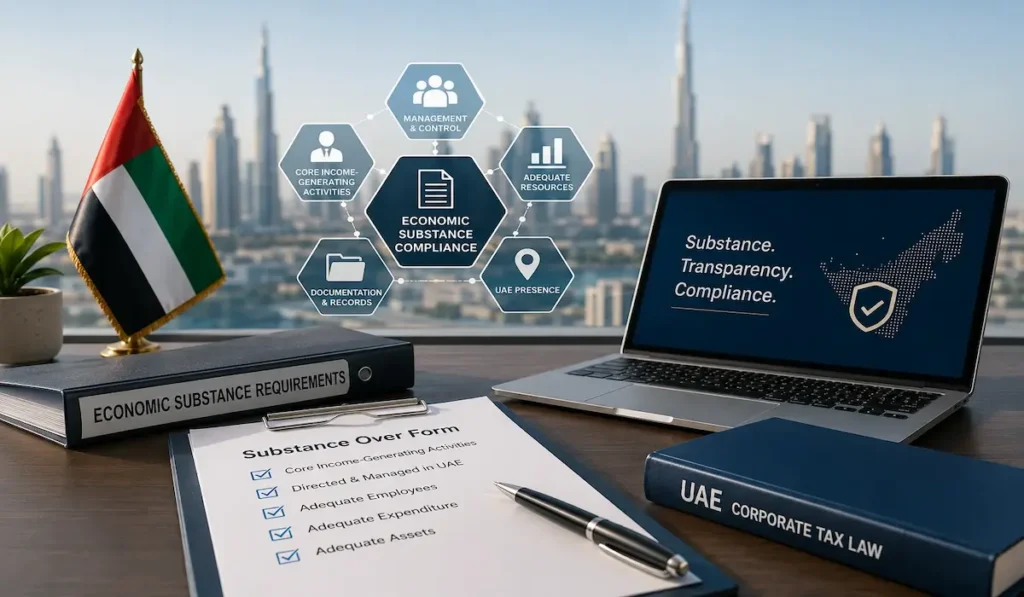
The standalone ESR regime ended, but the underlying substance principles were absorbed into the UAE Corporate Tax framework.
For free zone businesses seeking Qualifying Free Zone Person (QFZP) status, substance remains critical.
To qualify for the 0% Corporate Tax rate on qualifying income, a QFZP must generally demonstrate:
- Core Income-Generating Activities conducted in the free zone
- Adequate employees and operating expenditure
- Sufficient physical assets
- Management and control within the UAE
The same OECD BEPS principles that shaped ESR now influence the Corporate Tax regime.
What This Means for Different UAE Businesses
Free Zone Companies From 2023 Onwards
No standalone ESR filing obligations apply.
However, businesses seeking the 0% QFZP Corporate Tax rate must still satisfy substance requirements under the Corporate Tax framework.
Mainland Companies From 2023 Onwards
Mainland companies do not face standalone ESR obligations or QFZP substance requirements.
Standard Corporate Tax obligations apply, including:
- CT registration
- Annual tax return filing
- 9% Corporate Tax on taxable income above AED 375,000
Businesses With Unresolved 2019–2022 ESR Exposure
Any company that conducted Relevant Activities during the active ESR period should immediately review its historical filing position.
This is especially important for:
- Holding companies
- Headquarters entities
- Lease-finance businesses
- IP structures
Exempted Licensees Under ESR
Certain entities were exempt from full ESR obligations during the active ESR period.
These included:
- UAE government entities
- Certain UAE tax resident entities
- Branches taxed outside the UAE
- UAE-owned entities operating only within the UAE and outside multinational groups
However, exempt entities still had to submit ES Notifications to confirm their exempt status.
These exemptions only applied during the 2019–2022 ESR period. From 2023 onwards, there is no active standalone ESR regime.
Practical Steps for UAE Businesses in 2026?
Review Historical ESR Exposure
Determine whether your business conducted Relevant Activities and earned Relevant Income between 2019 and 2022.
Verify Historical ESR Filings
Check whether all ES Notifications and ES Reports were submitted correctly for the relevant periods.
Assess Refund Eligibility
If your business paid ESR penalties relating to post-2022 periods, apply for a refund through the Ministry of Finance e-refund portal.
Retain Supporting Documentation
Maintain records including:
- Board meeting minutes
- Employee documentation
- Financial statements
- Lease agreements
- FTA correspondence
Documentation should generally be retained for at least six years.
Shift Focus to Corporate Tax Compliance
For 2023 onwards, businesses should prioritise:
- UAE Corporate Tax registration
- Annual return filing
- QFZP eligibility assessment
- Transfer pricing compliance
- Substance documentation
Frequently Asked Questions
Has ESR been completely abolished in the UAE?
ESR filings no longer apply for financial years ending after 31 December 2022 under Cabinet Decision No. 98 of 2024. However, unresolved ESR obligations for 2019–2022 can still be reviewed by the FTA within the applicable audit window.
Do free zone companies still need to demonstrate economic substance after 2022?
Yes. Free zone businesses seeking QFZP status and the 0% Corporate Tax rate must still demonstrate adequate economic substance under the UAE Corporate Tax Law
Which regulatory authority was responsible for ESR enforcement?
The Federal Tax Authority (FTA) served as the National Assessing Authority for ESR compliance and penalties. Free zone authorities, DET, and ADGM Registration Authority managed filings within their jurisdictions.
What were the penalties for ESR non-compliance, and can I still be penalised?
ESR penalties ranged from AED 20,000 to AED 400,000 during the 2019–2022 period depending on the violation. The FTA can still assess penalties for unresolved non-compliance within its six-year audit window.
I paid ESR penalties for 2023 or later. Can I get a refund?
Yes. Any ESR penalties relating to financial years ending after 31 December 2022 are refundable under Cabinet Decision No. 98 of 2024.
My company had an IP-related structure. What are my ongoing obligations?
IP Businesses remain subject to FTA review for any applicable 2019–2022 ESR periods within the audit window. Businesses should retain all supporting records, including R&D documentation, board minutes, and financial statements.
Does ESR apply to holding companies?
Yes. Holding Company Business was one of the nine Relevant Activities under ESR during 2019–2022, although it had lighter substance requirements than most other activities.
How does IncHub assist with ESR legacy compliance and Corporate Tax substance?
IncHub assists businesses with reviewing unresolved ESR obligations for 2019–2022 and assessing potential FTA audit exposure. The firm also supports QFZP substance assessments and Corporate Tax compliance planning.
Key Takeaway
The UAE no longer requires ESR filings for financial years ending after 31 December 2022 following Cabinet Decision No. 98 of 2024. However, economic substance requirements have not disappeared. They now form part of the UAE Corporate Tax framework, particularly for free zone businesses seeking Qualifying Free Zone Person (QFZP) status and the 0% Corporate Tax rate. Businesses with unresolved ESR obligations from 2019–2022 should also review their historical filings and maintain supporting records, as the FTA audit window for those years is still open.
Verified Sources and References
All regulatory claims and figures have been verified against the following primary and authoritative sources.
1. UAE Ministry of Finance — ESR Official Portal and Public Announcement (14 October 2024)
2. UAE Ministry of Finance — Economic Substance Regulations Portal
3. ADGM — Economic Substance Regulations Update Circular (October 2024)
4. PwC Middle East — Cabinet Decision No. 98 of 2024: UAE ESR Update (October 2024)
6. Clyde & Co — UAE Economic Substance Regulations: Discontinued (October 2024)
7. DIFC — Economic Substance Regulations Overview
8. Fractional Dubai — ESR vs UAE Corporate Tax: What Changed (March 2026)