
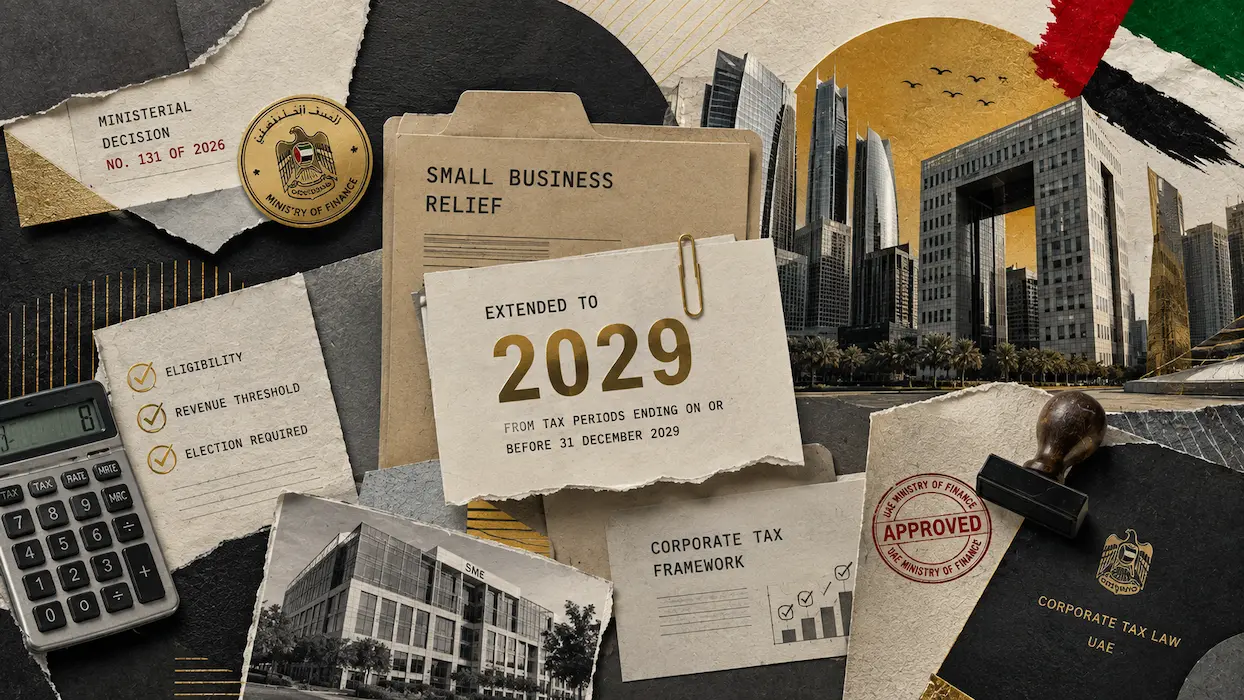
The UAE has extended Small Business Relief for Corporate Tax by three years, giving eligible small businesses and start-ups additional time to benefit from simplified Corporate Tax treatment.
On August 7, 2026, the UAE Ministry of Finance issued Ministerial Decision No. 131 of 2026, extending the availability of Small Business Relief from tax periods ending on or before December 31, 2026, to tax periods ending on or before December 31, 2029.
For UAE SMEs, entrepreneurs and start-ups, the extension provides greater certainty when planning Corporate Tax compliance, accounting systems and future business growth.
The key point is simple: the relief period has been extended, but the AED 3 million revenue threshold and existing eligibility conditions have not changed.
What Is UAE Small Business Relief?
Small Business Relief is a Corporate Tax relief available to eligible UAE resident Taxable Persons whose revenue falls within the prescribed threshold.
The relief was introduced under Ministerial Decision No. 73 of 2023 following the introduction of the UAE Federal Corporate Tax regime for tax periods beginning on or after June 1, 2023.
Where an eligible business elects for Small Business Relief, it can be treated as having no taxable income for the relevant tax period, subject to the conditions and requirements under the Corporate Tax rules.
The original relief was available for tax periods ending on or before December 31, 2026.
Ministerial Decision No. 131 of 2026 extends that deadline to December 31, 2029.
This means eligible UAE small businesses can potentially continue using Small Business Relief for qualifying tax periods through 2029.
What Changed Under Ministerial Decision No. 131 of 2026?
The main change is the extension of the Small Business Relief end date.
| Small Business Relief | Previous position | Updated position |
|---|---|---|
| Relief available until | December 31, 2026 | December 31, 2029 |
| Revenue threshold | AED 3 million | AED 3 million |
| Election required | Yes | Yes |
| Qualifying Free Zone Persons | Excluded | Excluded |
| Large Multinational Enterprise Groups | Excluded | Excluded |
Therefore, Ministerial Decision No. 131 of 2026 does not introduce a new Corporate Tax exemption or increase the revenue threshold.
It primarily extends the period during which eligible businesses can claim the existing relief.
What Is the UAE Small Business Relief Revenue Threshold?
The UAE Small Business Relief threshold remains AED 3 million in revenue.
Eligible businesses must continue to meet the applicable conditions under the Small Business Relief rules.
The extension to 2029 does not mean that every UAE business with revenue below AED 3 million automatically receives the relief.
Businesses must assess their eligibility and make the required election for each relevant tax period.
This distinction is important for UAE companies planning their Corporate Tax compliance.
Is the AED 3 Million Threshold Increasing to 2029?
No.
The AED 3 million revenue threshold remains unchanged.
Ministerial Decision No. 131 of 2026 extends the availability period for Small Business Relief but does not increase the revenue threshold.
Businesses should therefore continue monitoring revenue and other eligibility conditions rather than assuming that the relief will apply indefinitely.
Who Can Benefit From Small Business Relief in the UAE?
Small Business Relief is designed to support eligible smaller businesses operating under the UAE Corporate Tax framework.
Potentially affected businesses include:
- UAE-based small and medium-sized enterprises
- Start-ups and emerging businesses
- Entrepreneur-owned companies
- Professional and service businesses
- Trading businesses
- Other eligible resident Taxable Persons meeting the applicable conditions
However, meeting the AED 3 million revenue threshold alone is not sufficient.
Businesses must also satisfy the other conditions under the applicable Corporate Tax rules.
Is Small Business Relief Automatic in the UAE?
No. Small Business Relief is not automatic.
An eligible business must elect for the relief for the relevant tax period.
This means businesses should not assume that simply having revenue below AED 3 million will automatically result in Small Business Relief being applied.
Corporate Tax compliance teams should review the election requirement when preparing the relevant Corporate Tax return and maintain appropriate records supporting the business’s eligibility.
What Has Not Changed With Small Business Relief?
The 2029 extension does not change several important aspects of the UAE Small Business Relief regime.
The AED 3 Million Revenue Threshold Remains
The existing AED 3 million revenue threshold remains in place.
The extension does not increase the threshold to AED 5 million, AED 10 million or any other amount.
Businesses Must Still Elect for the Relief
Small Business Relief must still be elected for the relevant tax period.
It should not be treated as an automatic Corporate Tax exemption.
Qualifying Free Zone Persons Remain Excluded
Qualifying Free Zone Persons (QFZPs) that have elected to benefit from the applicable 0% Corporate Tax treatment for qualifying Free Zone income remain excluded from Small Business Relief.
The 2029 extension does not change this position.
Certain Large Multinational Enterprise Groups Remain Excluded
Members of Multinational Enterprise Groups meeting the applicable consolidated revenue threshold remain outside the Small Business Relief regime.
The relevant threshold is AED 3.15 billion in consolidated group revenue.
Corporate Tax Compliance Does Not Disappear
Small Business Relief does not mean that businesses can ignore their Corporate Tax obligations.
Eligible businesses should continue maintaining appropriate accounting records, monitoring revenue and complying with applicable registration, filing and record-keeping requirements.
What Does the 2029 Extension Mean for UAE SMEs?
The extension provides UAE small businesses with a longer planning horizon.
Under the previous rules, businesses were preparing for the potential end of Small Business Relief after 2026.
The new deadline gives eligible businesses additional time before they may need to transition to standard Corporate Tax calculations, subject to their individual circumstances.
More Time to Prepare for Corporate Tax Compliance
Businesses approaching the AED 3 million revenue threshold can use the additional period to improve their accounting and tax processes.
This may include:
- Improving bookkeeping systems
- Separating business and personal transactions
- Reviewing deductible expenses
- Maintaining supporting documentation
- Establishing reliable revenue reporting
- Preparing for taxable income calculations
- Reviewing Corporate Tax registration and filing processes
- Working with qualified tax professionals where necessary
Greater Planning Certainty for Start-Ups
For UAE start-ups, the extension provides more certainty when forecasting growth.
A business that is currently below the AED 3 million threshold may have additional time to develop its operations before transitioning to standard Corporate Tax compliance, provided it continues to meet all applicable conditions.
However, businesses should not delay tax planning simply because Small Business Relief has been extended.
Rapidly growing companies can reach the threshold sooner than expected.
What Happens If Your UAE Business Exceeds AED 3 Million?
Businesses approaching the AED 3 million threshold should monitor their revenue carefully.
If a business no longer satisfies the requirements for Small Business Relief for a particular tax period, it may need to move to the standard Corporate Tax treatment applicable to its circumstances.
This can involve:
- Determining taxable income
- Applying permitted deductions and adjustments
- Reviewing applicable Corporate Tax rates
- Maintaining more detailed tax records
- Preparing the relevant Corporate Tax return
- Assessing available Corporate Tax reliefs and elections
The 2029 extension should therefore be viewed as additional planning time, not a reason to postpone Corporate Tax preparation.
Does Small Business Relief Apply to UAE Free Zone Companies?
This depends on the company’s specific Corporate Tax position.
A Qualifying Free Zone Person that has elected to benefit from the 0% Corporate Tax regime for qualifying income is excluded from Small Business Relief.
Therefore, UAE Free Zone companies should not assume that being below the AED 3 million revenue threshold automatically makes them eligible for Small Business Relief.
Free Zone businesses should first determine whether they qualify for the applicable Free Zone Corporate Tax regime and assess the interaction with Small Business Relief based on their individual circumstances.
Small Business Relief vs UAE Corporate Tax: What Is the Difference?
Small Business Relief should not be confused with the UAE’s general Corporate Tax regime.
The UAE Corporate Tax system applies to businesses within its scope, subject to applicable rates, exemptions, reliefs and other rules.
Small Business Relief is a specific relief available to qualifying businesses that satisfy the relevant requirements.
Therefore:
- UAE Corporate Tax = the broader federal tax framework.
- Small Business Relief = a specific relief available to eligible businesses under that framework.
The extension to 2029 affects the availability period of the relief, not the overall UAE Corporate Tax system.
Does the Extension Affect UAE VAT?
No.
The extension of Small Business Relief applies specifically to UAE Corporate Tax.
It does not change:
- UAE VAT registration requirements
- VAT filing obligations
- VAT rates
- VAT record-keeping requirements
- VAT deregistration rules
Businesses should assess Corporate Tax and VAT separately because the two tax regimes have different rules and thresholds.
What Should UAE Businesses Do Now?
The extension provides additional time, but businesses should still take proactive steps.
Recheck Your Small Business Relief Eligibility
Review your revenue and other applicable conditions for every relevant tax period.
Do not assume that eligibility will continue automatically.
Make the Required Election
Eligible businesses should ensure that the required Small Business Relief election is made for the relevant tax period.
Monitor Revenue Growth
Businesses approaching AED 3 million in revenue should establish regular monitoring procedures.
Revenue growth can change the company’s Corporate Tax position and may require a transition to standard Corporate Tax compliance.
Review Your Accounting Systems
Use the additional time to strengthen bookkeeping, financial reporting and tax record-keeping.
Businesses that expect significant growth should consider implementing processes capable of supporting full Corporate Tax calculations.
Revisit Previous 2026 Planning
Some businesses may have made structural or compliance plans based on the original 2026 Small Business Relief deadline.
The 2029 extension provides an opportunity to reassess those plans and determine whether they are still commercially necessary.
Do Not Use Entity Splitting Solely to Preserve Relief
Businesses should be particularly careful about restructuring or creating additional entities purely to remain within a relief threshold.
Corporate Tax planning should consider the wider UAE tax rules, commercial substance, related-party relationships and applicable anti-abuse provisions.
Professional advice should be obtained before implementing significant restructuring.
Key Takeaways for UAE Small Businesses
The UAE Small Business Relief extension provides three additional years of availability for eligible businesses.
The most important points are:
- Small Business Relief is now available for qualifying tax periods ending on or before December 31, 2029.
- The AED 3 million revenue threshold remains unchanged.
- Businesses must still elect for the relief where required.
- Qualifying Free Zone Persons benefiting from the applicable 0% Free Zone Corporate Tax regime remain excluded.
- Certain members of Multinational Enterprise Groups remain excluded.
- The extension does not change UAE VAT obligations.
- Businesses approaching AED 3 million should prepare for the possibility of standard Corporate Tax compliance.
- The 2029 deadline gives businesses more time for planning, but it does not remove their wider Corporate Tax obligations.
For UAE SMEs and start-ups, the key benefit is additional time and greater certainty. Businesses can use this period to strengthen their accounting systems, monitor growth and prepare for the Corporate Tax obligations that may apply as their business expands.
Frequently Asked Questions
What This Means for Your Business
The extension of UAE Small Business Relief to 2029 gives eligible SMEs and start-ups a longer period to benefit from the existing relief.
However, the fundamental rules remain unchanged. The AED 3 million threshold remains in place, the relief requires an election, and specific categories of businesses remain excluded.
Businesses should therefore treat the announcement as a planning opportunity rather than a permanent exemption from UAE Corporate Tax.
If your business is approaching the AED 3 million revenue threshold, operating from a UAE Free Zone, or undergoing significant growth or restructuring, reviewing your Corporate Tax position now can help you prepare for the next stage of your business.
IncHub Financial Services FZCO can help businesses assess their UAE Corporate Tax position, review Small Business Relief eligibility and prepare for ongoing tax compliance.
Review Your Small Business Relief Position
IncHub Financial Services FZCO helps UAE SMEs and start-ups assess their Corporate Tax position and prepare for ongoing tax compliance.
Book a Free Consultation